T: +86-18367823571
E: lyy@xg1688.cn
E: lyy@xg1688.cn
Building 2, No. 84, Qingxi Dongfeng Road, Qingxi Town, Dongguan City, Guangdong Province, 523642, China

Views: 0 Author: Site Editor Publish Time: 2026-10-12 Origin: Site
Rice and wheat combine harvesters share the same basic purpose: cutting crops, separating grain, and collecting the harvested grain. However, crop characteristics, soil conditions, and harvesting requirements affect how these machines are configured and operated.
A rice combine harvester often needs strong traction and good flotation in wet paddy fields. A wheat combine harvester must handle mature wheat efficiently, usually under firmer field conditions. However, some modern combines can harvest both crops when configured appropriately.
This guide compares rice and wheat combine harvesters by crop conditions, machine structure, traction, performance, maintenance, and purchasing considerations. Explore the Thinker combine harvester range to review available models.
Table of Contents
The main differences relate to field conditions, crop handling, and machine configuration. The table below summarizes common considerations. Actual specifications vary by model and manufacturer.
Comparison Factor | Rice Combine Harvester | Wheat Combine Harvester |
|---|---|---|
Typical field conditions | Wet, soft, or muddy paddy fields | Often firmer and drier fields |
Traction system | Tracks or suitable wide tyres, depending on conditions | Tyres or tracks, depending on the machine and terrain |
Crop handling | Must manage rice panicles and crop residue under the prevailing moisture conditions | Must handle wheat heads, straw, and potential grain shattering |
Header requirements | Must suit rice crop height, density, and field conditions | Must suit wheat height, density, and lodging conditions |
Threshing and cleaning | Settings depend on rice variety, grain moisture, and residue | Settings depend on wheat variety, grain moisture, and straw conditions |
Key selection factors | Soil bearing capacity, water conditions, turning space, and crop requirements | Field size, terrain, crop condition, capacity, and transport needs |
These are general comparisons rather than fixed rules. A machine's suitability depends on its design, available attachments, and operating conditions.
Rice and wheat differ in their plant structure, growing environment, and harvesting conditions. These differences influence header selection, feeding, threshing, and cleaning.
Rice is commonly grown in paddy fields that may be flooded or saturated during the growing season. At harvest, the actual soil moisture and surface conditions vary by region and farming practice.
Soft soil can increase the risk of wheel slip, machine sinking, and deep ruts. Rice harvesting equipment may therefore use crawler tracks or other suitable traction systems to improve mobility.
Rice panicles and straw also require appropriate crop feeding and threshing adjustments. Operators should follow the manufacturer's guidance and monitor grain loss, unthreshed material, and grain damage.
Wheat is often harvested in firmer fields, although soil conditions vary with rainfall, irrigation, and terrain. Mature wheat may also lodge, or bend toward the ground, which can complicate cutting and feeding.
The header must gather wheat consistently and minimize losses from missed heads or grain shattering. Threshing and cleaning settings should match crop moisture, straw condition, and grain quality requirements.
For both crops, correct adjustment is more important than assuming that one universal setting works for every field.
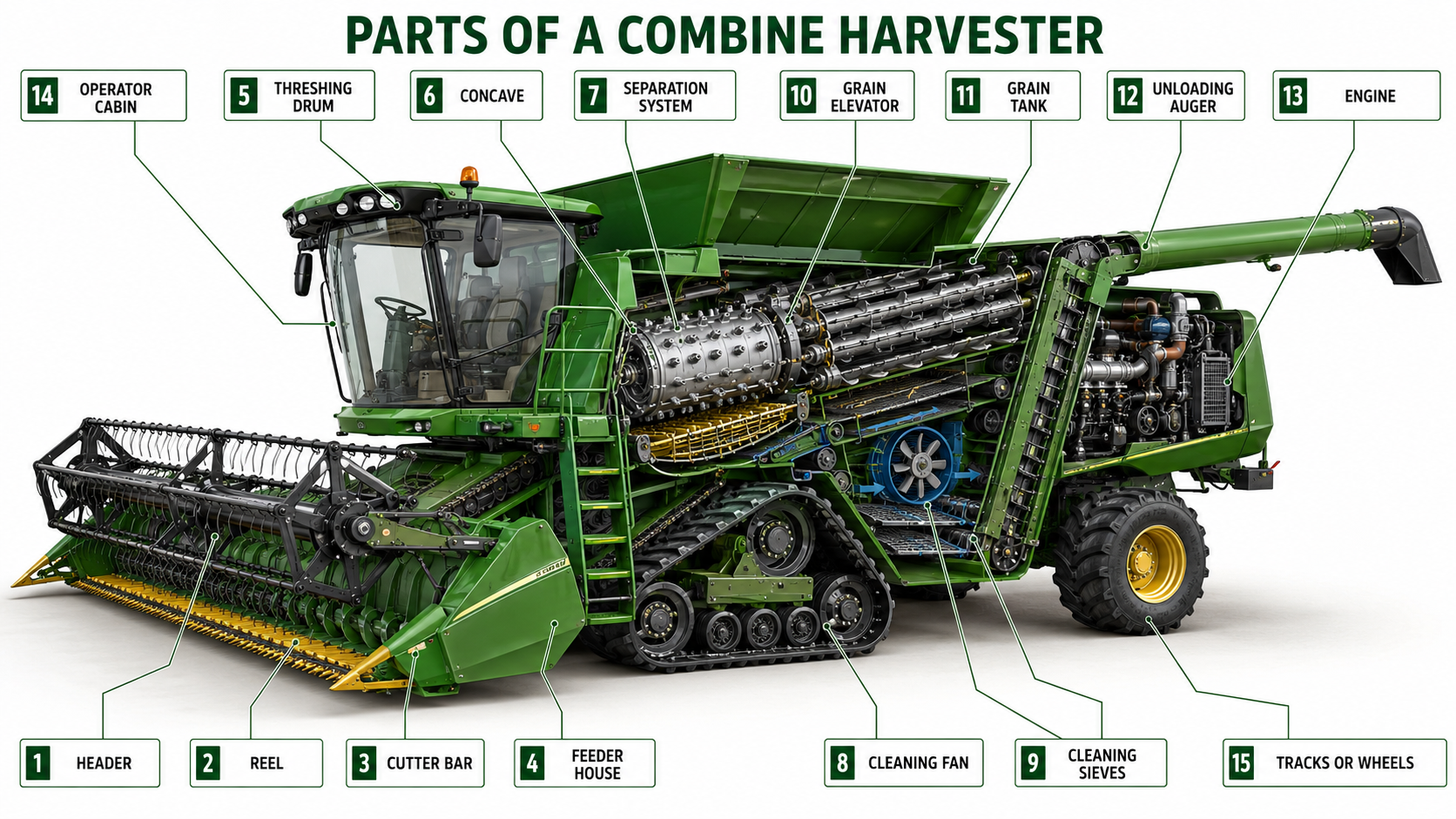
A combine harvester uses several systems to gather crops, separate grain, remove impurities, and store the harvested grain. Their configuration may vary according to the crop and machine model.
The header cuts and gathers standing crops before feeding them into the machine. Its width, reel adjustment, cutter bar, and feeding design influence crop flow and harvesting losses.
For rice, operators need a header configuration that suits the crop's height, density, and field surface. For wheat, the header should gather mature heads effectively, including where crops are uneven or lodged.
A standard grain header may be suitable for both rice and wheat when the machine is designed and configured for these crops. Buyers should confirm the header type and available adjustments rather than assume that all rice and wheat machines use different cutting mechanisms.
The threshing system releases grain from the harvested crop material. The separation system then recovers grain that remains among the straw or other residue.
Rice and wheat may require different operating settings because their varieties, moisture levels, and straw conditions vary. Drum or rotor speed and concave clearance should follow the operator's manual and be adjusted based on field results.
Excessive threshing intensity may damage grain, while insufficient threshing may leave grain in the crop residue. The goal is to balance grain recovery, grain quality, and machine capacity.
Cleaning systems use sieves and airflow to separate grain from chaff and other impurities. The correct settings depend on crop characteristics, grain moisture, residue conditions, and machine design.
Operators should monitor grain cleanliness and losses during operation. Grain tanks and unloading systems also affect work continuity, especially when transport vehicles are not readily available.
For more detail about individual components, read Thinker Agri's guide to combine harvester parts and their functions.
The traction system is an important factor when choosing a rice or wheat combine harvester. However, the decision should be based on field conditions rather than crop name alone.
Crawler tracks distribute machine weight over a larger contact area than many conventional tyre configurations. This can improve flotation and reduce the risk of sinking in soft soil.
Tracks may be useful in wet paddy fields, but performance still depends on machine weight, track width, soil bearing capacity, water depth, and operating technique.
Track systems also require regular inspection. Operators should check track tension, wear, undercarriage components, and accumulated mud according to the maintenance schedule.
Tyres can provide good mobility and transport performance on firm ground. The appropriate tyre size, tread, load rating, and inflation pressure depend on the machine and field conditions.
Some harvesters are available in wheeled configurations, while others use tracks even for multi-crop harvesting. Therefore, a wheat combine is not necessarily wheeled, and a rice combine is not necessarily tracked.
Before purchasing, assess the soil conditions during harvest, field access, transport routes, turning space, and the machine's load when the grain tank is full.
Harvesting efficiency depends on more than machine type. Crop maturity, field conditions, header width, feeding capacity, machine settings, and operator experience all affect results.
A combine working in soft or muddy soil may need a lower forward speed to maintain traction and avoid excessive soil disturbance. Firmer fields may allow faster operation when crop flow and machine capacity permit.
However, forward speed alone does not determine productivity. A wider header or higher feeding capacity may improve field output, but only if the machine can process the incoming crop effectively.
Compare the manufacturer's rated capacity with your field size, crop yield, field layout, and available transport equipment.
Both rice and wheat combines can lose grain through missed crop, incomplete threshing, separation losses, or cleaning losses.
To manage these risks:
Adjust the header to the crop height and field surface.
Check that crop material feeds evenly into the machine.
Adjust threshing and cleaning settings according to the manual.
Inspect grain in the tank and residue behind the combine.
Reduce forward speed when crop flow becomes uneven or losses increase.
Regular monitoring helps operators identify problems before they lead to significant losses.
Rice and wheat harvesting expose equipment to different combinations of moisture, dust, crop residue, and mechanical load. Maintenance requirements therefore depend on the machine and working environment.
Mud and moisture can accumulate around tracks, the undercarriage, headers, and other exposed components. Cleaning these areas helps operators identify wear, damage, and potential blockages.
After operation, follow the manufacturer's cleaning and inspection procedures. Pay particular attention to lubrication points, bearings, seals, electrical connections, and areas where moisture or debris may collect.
Dry harvesting can generate substantial dust and chaff. Air filters, cooling areas, fans, and moving components may require frequent inspection and cleaning.
Operators should also inspect belts, chains, cutter sections, bearings, and other wear parts. Maintenance intervals should follow the operator's manual and account for actual working conditions.
For either crop, preventive maintenance before harvest can reduce unexpected downtime during the operating season.
The purchase price of a rice or wheat combine harvester varies by model, capacity, engine power, traction system, configuration, market, and after-sales support. It is not reliable to assume that every rice combine costs more than every wheat combine.
When comparing quotations, consider the following factors:
Machine capacity: Match feeding capacity and cutting width to your expected workload.
Traction configuration: Check whether tracks or tyres suit your field conditions.
Crop compatibility: Confirm that the machine and header are suitable for the crops you intend to harvest.
Operating costs: Estimate fuel, maintenance, replacement parts, labour, and transportation costs.
After-sales support: Check spare-parts availability, warranty terms, and access to technical assistance.
Used-machine condition: Inspect operating hours, maintenance records, wear parts, hydraulic systems, and the undercarriage before buying.
A lower initial price does not always mean a lower total cost. Compare the expected cost of ownership over the machine's working life.
If your farm grows both rice and wheat, a multi-crop combine may reduce the need to purchase separate machines. However, buyers must verify the model's approved crop applications and the adjustments or attachments required for each crop.
For example, Thinker Agri lists rice and wheat among the suitable crops for its 4LZ-6.0Z tracked combine harvester and 4LZ-7.0Z combine harvester. Confirm the final configuration with the supplier before ordering.
The main differences between rice and wheat combine harvesters involve crop handling, traction requirements, operating settings, and field conditions. Rice harvesting in soft or muddy paddies may benefit from a tracked machine, while firm wheat fields may suit wheeled or tracked configurations depending on the terrain and equipment design.
The best choice depends on crop compatibility, field size, soil conditions, harvesting capacity, maintenance needs, and total ownership cost. Review the available Thinker combine harvester models and confirm the specifications required for your farm before making a purchasing decision.
The main differences involve crop handling, field conditions, traction requirements, and operating settings. Rice harvesting may require better flotation in wet soil, while wheat harvesting often takes place on firmer ground.
No. Tracks are common in machines designed for soft or muddy paddy fields, but some machines use suitable tyres. The right configuration depends on soil conditions and the machine's design.
Yes, some multi-crop combine harvesters are designed for both crops. Buyers should confirm crop compatibility, header requirements, and the adjustments needed for each harvesting task.
Use the correct header settings, maintain even crop feeding, adjust threshing and cleaning systems according to the operator's manual, and monitor grain losses during operation.
Consider crop compatibility, field conditions, traction system, working capacity, maintenance costs, spare-parts availability, and local after-sales support.