T: +86-18367823571
E: lyy@xg1688.cn
Building 2, No. 84, Qingxi Dongfeng Road, Qingxi Town, Dongguan City, Guangdong Province, 523642, China

Views: 0 Author: Site Editor Publish Time: 2026-11-27 Origin: Site
Commercial grain dryer capacity should be determined by peak daily grain intake, available operating hours, initial moisture content, and target storage moisture levels. Batch grain dryers provide flexible processing and precise moisture control for individual grain lots, while continuous-flow systems support sustained high-volume drying at commercial grain storage facilities.
This article compares seven commercial grain drying options, including specific Thinker Agri grain dryer models and industrial drying configurations. It examines their processing capacities, drying performance, energy requirements, operating costs, and suitability for different grain storage operations.
Table of Contents
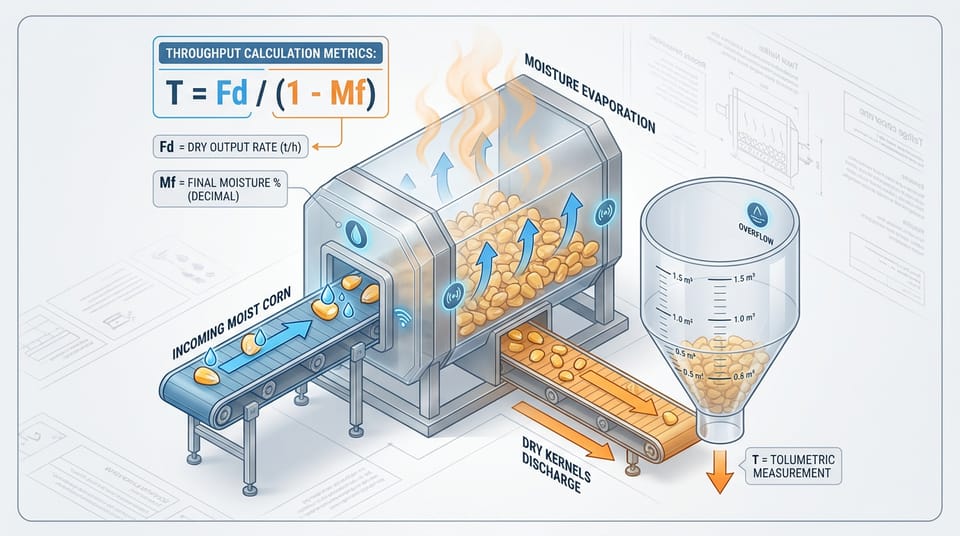
To determine the required drying throughput, you must establish the daily receiving tonnage, initial moisture content, and target storage moisture level. Dividing daily wet intake by operational hours provides your baseline ton-per-hour requirement. Sizing also depends on the drying rate of specific grains, as seed structure alters transit speed; for instance, research demonstrates that wheat dries faster than maize and rice under identical processing flows.
Accurately standardizing dryer performance requires calculating conversion coefficients between drying capacity and specific heat consumption under shifting ambient conditions. Testing guidelines documented in engineering literature confirm that adjustments for moisture variation prevent severe errors in equipment sizing. When operators miscalculate these conversion rates, they risk running undersized systems that bottleneck intake. Attempting to compensate by elevating burner heat causes thermal stress-cracking and loss of germination viability.
Metric | Calculation Purpose | Impact on Equipment Sizing |
|---|---|---|
Ton-per-Hour Intake | Establishes baseline wet volume per operating hour | Sets minimum mechanical throughput requirement |
Moisture Extraction (%) | Quantifies the required moisture reduction and helps determine the total mass of water to be removed. | Determines burner thermal output and airflow volume |
Specific Heat Consumption | Measures energy used per unit of evaporated water | Identifies thermal efficiency and operating fuel costs |
Evaluating these parameters ensures that subsequent plant modifications or grain dryer reconstruction with increasing capacity remain energy-efficient without exceeding recommended internal seed temperatures.
The minimum required hourly drying capacity can be calculated using the following formula:
Required Drying Capacity (t/h) = Daily Wet Grain Intake (t) ÷ Available Drying Hours (h)
For example, a commercial grain storage facility receiving 200 metric tons of wet grain per day and operating its drying equipment for 20 hours requires an average drying capacity of at least 10 metric tons per hour.
Parameter | Example Value |
|---|---|
Daily Wet Grain Intake | 200 tons |
Available Operating Time | 20 hours |
Minimum Required Drying Capacity | 10 tons/hour |
Initial Grain Moisture | 25% |
Target Grain Moisture | 14% |
Moisture Reduction | 11 percentage points |
For batch grain dryers, the effective hourly throughput must also account for loading, drying, tempering, cooling, and unloading time. For continuous-flow dryers, the rated throughput should be evaluated at the actual incoming and target moisture levels.
This calculation helps commercial grain storage operators determine whether a single dryer, multiple batch dryers, or a continuous-flow drying system is required.
Evaluating commercial high-throughput models requires balancing daily volume intake against capital expenditure, thermal limits, and fuel consumption profiles. Commercial operations generally adopt either circulating batch units or continuous-flow systems to match their specific processing logistics. The following seven configurations represent established architectures engineered to maintain grain quality across varied throughput volumes.
Batch Capacity Sizing: Holds approximately 16 metric tons per charge, suiting mid-sized commercial farms or regional aggregation hubs that process distinct crop varieties separately.
Low-Temperature Recirculation: Employs continuous cycle movement at reduced air temperatures to protect endosperm integrity and prevent kernel stress cracking.
Moisture Gradient Mitigation: Mitigates internal moisture gradients through phased exposure, allowing grain kernels to temper between passes through the heating section.
Operational Cycle Management: Relies on sequenced batch cycles rather than continuous discharge, giving operators precise control over the final discharge moisture before unloading.
Targeted Grain Application: Designed specifically for high-grade milling crops and commercial seed stock where thermal shock degrades germination viability.
Stress-Crack Prevention: Utilizes low-temperature grain circulation to minimize thermal stress and reduce kernel cracking during batch drying.
Tempered Moisture Extraction: Balances air volume and grain circulation speeds so that moisture transfers slowly from the seed core to the outer hull.
Volume Flexibility: Accommodates 20-ton operational batches, bridging the gap between small farm dryers and high-capacity industrial terminals.
Expanded Holding Sizing: Provides an expanded 30-ton holding capacity designed for multi-batch receiving stations handling intense intake spikes during harvest peaks.
Centralized Air Distribution: Incorporates high-volume centralized airflow channels that ensure uniform heat delivery throughout the enlarged drying bed.
Intake Temperature Stability: Controlled airflow and temperature management help maintain stable drying performance under varying ambient temperatures and humidity conditions.
Discharge Efficiency: Features high-capacity augers and bucket elevators that speed up charging and discharging phases, thereby cutting overall turnaround times between batches.
The Thinker Agri 5HHL-4 is a mobile batch grain dryer designed for decentralized grain collection, smaller storage facilities, and supplementary drying operations during peak harvest periods.
Batch Capacity: Processes 2–4 metric tons of grain per batch, supporting flexible drying of smaller grain lots.
Low-Temperature Drying: Provides controlled moisture removal with a drying rate of 0.5–1.2% per hour.
Energy Requirements: Features a listed drive-system power of 2.1 kW, a 220 V power supply, and an integrated biomass or firewood heating system.
Mobile Operation: Its vehicle-mounted configuration enables grain drying at different collection and storage locations.
Commercial Applications: Suitable for regional grain collection points, segregated crop lots, and supplementary drying where permanent installations are impractical.
The 5HHL-4 is particularly useful as a supplementary drying solution rather than the primary dryer for large-volume commercial grain terminals.
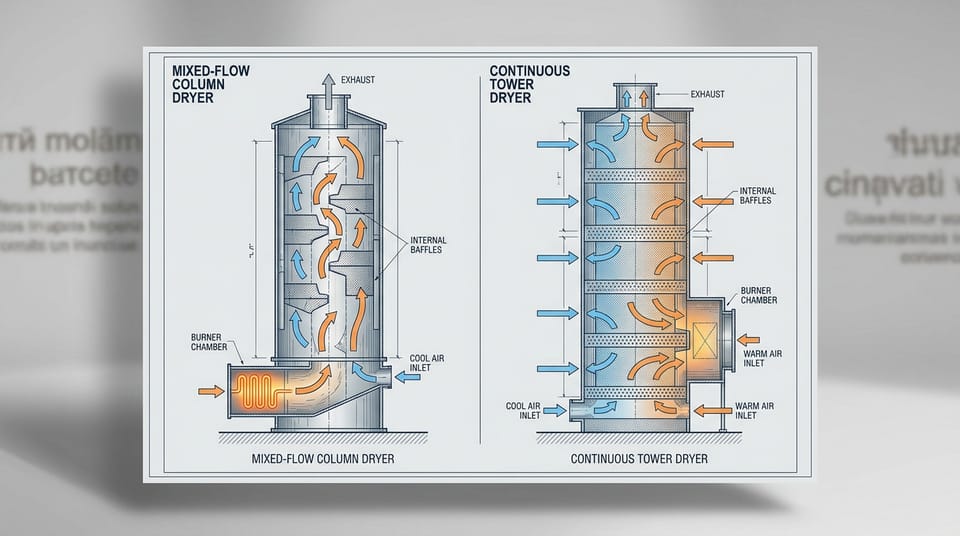
Screenless Air Ducting: Uses alternating rows of inlet and exhaust ducts to move air through the grain column without requiring screens that clog with crop residue.
Uniform Kernel Exposure: Delivers heat from multiple directions as kernels move downward, ensuring every kernel experiences nearly identical thermal and airflow conditions.
Lower Operating Costs: Optimized airflow and multidirectional heat distribution can reduce fuel consumption per unit of grain dried compared with conventional cross-flow designs.
Multi-Crop Handling: Processes diverse commodities—such as corn, soybeans, wheat, and canola—without necessitating screen changeovers or duct alterations.
Gravity-Assisted Transit: Relies on natural gravitational downward movement through vertical columns, minimizing the mechanical wear associated with internal circulation screws.
Heat Recovery Integration: Reclaims warm exhaust air from lower cooling sections to preheat incoming grain, significantly cutting fuel requirements in large facilities.
Upgraded Column Geometry: Increases hourly processing capacity by retrofitting existing tower layouts with wider grain paths and optimized fan configurations.
High-Throughput Footprint: Delivers massive processing volumes within a compact vertical footprint, making it ideal for facilities where ground space is constrained.
Automated Thermal Precision: Incorporates proportional-integral-derivative (PID) control prototypes to modulate supplemental burners automatically, maintaining stable drying chamber temperatures.
Renewable Energy Integration: Uses roof-mounted thermal collectors to harness solar energy, reducing fossil fuel consumption during clear daytime operating windows.
Tropical Installation Suitability: Provides an efficient design basis for a solar-heated grain dryer for the tropics, where ambient temperatures and solar radiance remain consistently high.
Hybrid Operational Flexibility: Combines solar thermal energy with conventional auxiliary heating to support drying operations during cloudy weather and nighttime shifts.
Grain dryer capacity varies according to the equipment design, crop type, moisture reduction requirements, and operating cycle. Batch capacity represents the amount of grain processed in a single drying cycle, whereas continuous drying capacity is generally expressed in metric tons per hour.
Brand / Dryer Model | Operating Type | Batch Capacity | Listed Hourly Capacity | Recommended Applications |
|---|---|---|---|---|
Thinker Agri 5H-16 | Batch circulation | 16 t | Contact manufacturer | Small to medium grain storage facilities |
Thinker Agri 5H-20 | Batch circulation | 20 t | Contact manufacturer | Agricultural cooperatives and regional storage centers |
Thinker Agri 5H-30 | Batch circulation | Up to 30 t for rice; 34 t for corn and wheat | Rice: ≥2 t/h; Corn and wheat: ≥2.7 t/h | Large farms and commercial storage facilities |
Thinker Agri 5HHL-4 | Mobile batch | 2–4 t | ≥0.5 t/h (handling capacity) | Supplementary and decentralized drying |
Industrial Mixed-Flow Dryer | Continuous | — | Model-dependent | High-volume commercial grain processing |
Commercial Vertical Tower Dryer | Continuous | — | Model-dependent | Large grain elevators and storage terminals |
PID-Controlled Solar-Assisted Hybrid Dryer | System-dependent | System-dependent | System-dependent | Facilities integrating renewable thermal energy |
Batch capacity and hourly drying capacity should not be treated as interchangeable measurements. The actual hourly output of a batch dryer depends on the total drying cycle, including grain loading, moisture removal, cooling, and unloading. Listed hourly capacities should be confirmed against the required moisture reduction before equipment sizing.
For facilities receiving large quantities of grain during a short harvesting window, multiple batch dryers operating in parallel can provide an alternative to a single large continuous-flow dryer while maintaining flexibility for different crop varieties.
Energy consumption is a major component of commercial grain drying costs. Different dryer configurations use different combinations of thermal energy and electrical power to remove moisture, circulate grain, and maintain airflow. The most economical solution depends on annual processing volume, local fuel prices, drying temperature, and moisture removal requirements.
Grain Dryer Model / Type | Thermal Energy Source | Rated Electrical Power | Drying Performance | Key Operating Cost Factors |
|---|---|---|---|---|
Thinker Agri 5H-16 | Furnace-based heating | Consult manufacturer | Low-temperature circulation | Fuel consumption, batch duration, and loading frequency |
Thinker Agri 5H-20 | Furnace-based heating | Consult manufacturer | Low-temperature circulation | Fuel costs, electrical consumption, and equipment utilization |
Thinker Agri 5H-30 | Natural gas, diesel, or biomass, depending on configuration | 19.15 kW | 0.6–1.0%/h | Fuel prices, fan power, and batch loading rate |
Thinker Agri 5HHL-4 | Biomass or firewood | 2.1 kW for drive system | 0.5–1.2%/h | Biomass prices, auxiliary electricity, and transportation |
Industrial Mixed-Flow Dryer | Commonly natural gas or LPG | Model-dependent | Continuous drying with multidirectional airflow | Burner efficiency, airflow resistance, and operating hours |
Commercial Vertical Tower Dryer | Commonly natural gas or LPG | Model-dependent | Continuous drying with heat recovery | Fuel consumption, electrical demand, and maintenance |
PID-Controlled Solar-Assisted Hybrid Dryer | Solar thermal energy and auxiliary heating | System-dependent | Weather-dependent drying with automated temperature control | Solar availability, auxiliary fuel consumption, and system maintenance |
Fuel-fired grain dryers consume thermal energy to evaporate moisture, while electricity powers fans, elevators, augers, and automated control systems.
Low-temperature batch dryers provide greater flexibility when drying segregated grain lots and moisture-sensitive crops. Continuous mixed-flow and tower dryers can achieve lower energy and labor costs per ton when operating near their designed capacity.
Solar-assisted hybrid dryers can reduce conventional fuel demand during periods of sufficient solar radiation, although their overall energy savings depend on collector capacity, climate conditions, and auxiliary heating requirements.
Commercial grain storage operators can compare the direct operating costs of different drying systems using the following formula:
Operating Cost per Ton = (Fuel Cost + Electricity Cost + Labor Cost + Maintenance Cost) ÷ Total Grain Processed
Cost Component | Recommended Comparison Metric |
|---|---|
Natural Gas Consumption | m³ per ton of grain dried |
LPG or Diesel Consumption | Liters per ton of grain dried |
Biomass Consumption | kg per ton of grain dried |
Electricity Consumption | kWh per ton of grain dried |
Thermal Energy Efficiency | MJ per kg of water removed |
Labor Cost | Labor cost per ton of grain dried |
Total Operating Cost | Cost per ton of grain dried |
To ensure a meaningful comparison, all grain dryers should be evaluated using the same crop type, initial moisture content, target moisture content, and operating conditions. A dryer with higher installed motor power does not necessarily have higher operating costs per ton if it processes a greater volume of grain within the same period.
Dryer configuration directly dictates maximum recommended internal kernel temperatures to preserve end-use grade and germination viability. Sizing commercial Grain Dryer Capacity requires balancing throughput goals against these distinct biological boundaries to prevent irreversible commodity downgrades.
Operating above recommended thermal thresholds causes internal stress-cracking, lowers overall test weight, and denatures vital proteins or starches. Milled rice develops broken kernels, while malting barley and planting seeds lose their ability to sprout when exposed to excessive heat.
Continuous high-heat designs, such as cross-flow and mixed-flow towers, apply drying air temperatures between 65°C and 95°C. These systems demand strict monitoring and dedicated in-line cooling stages to reduce kernel heat before final bin aeration. Modern facilities often install an automatic grain dryer prototype using PID temperature control to stabilize burner output against sudden ambient fluctuations.
In contrast, recirculating batch and circular drying units operate under lower temperature profiles, typically keeping grain heat below 45°C. By circulating kernels continuously through alternating temper zones, these configurations avoid localized overheating, making them well suited for sensitive oilseeds, food-grade soybeans, and seed grain.
Discover practical approaches to boost processing volume and trim operating expenses by systematically upgrading legacy
Commercial storage operators can expand processing throughput and curb operating expenses by systematically updating older installations rather than investing in new infrastructure. Following disciplined Grain Dryer Capacity best practices ensures mechanical retrofits elevate intake volume without compromising grain quality:
1. Conduct baseline thermal efficiency testing: Measure current fuel usage against water mass removed to determine your specific heat consumption conversion factor before altering components.
2. Upgrade internal ducting and air distribution paths: Reconfigure supply ducts and exhaust louvers to balance static pressure across grain columns, accelerating drying without generating localized cold air pockets.
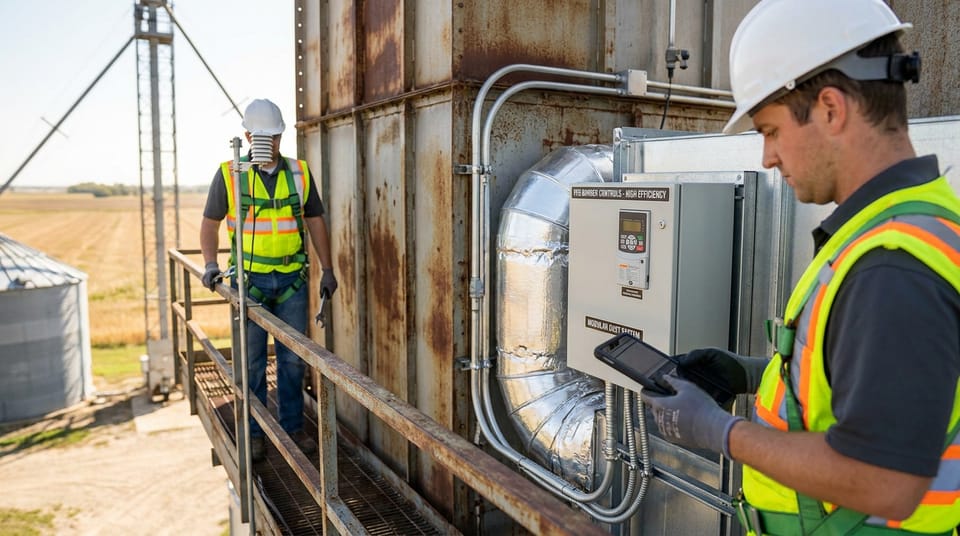
3. Integrate automated closed-loop PID controls: Install proportional-integral-derivative modules paired with real-time moisture sensors to reduce manual adjustments, minimize over-drying, and improve fuel efficiency.
These retrofits fail if burner capacity cannot maintain uniform airflow temperatures under higher throughput speeds, leading to uneven moisture profiles across discharge bins. Operators must verify that supply fans deliver adequate static pressure across expanded grain depths before commissioning upgraded controls.
Finalizing commercial Grain Dryer Capacity requires balancing peak daily harvest receipts against specific heat consumption rather than relying solely on rated nameplate volume. Continuous towers maximize transit speed for high-volume delivery points, whereas circulating batch units provide precise thermal control to protect milling quality and seed viability.
Before committing capital to full facility expansions, audit existing burner profiles, measure temperature limits across your target crops, and evaluate duct or PID control upgrades. Operators can then select replacement dryers or targeted retrofits suited to their throughput goals.
Thinker Agri offers batch grain dryers with nominal capacities of 16, 20, and 30 metric tons per batch through its 5H-16, 5H-20, and 5H-30 models. The 5H-30 can accommodate up to 34 metric tons of corn or wheat per batch.
Mobile models such as the 5HHL-4 offer a batch capacity of 2–4 metric tons for smaller or supplementary drying operations. Large commercial grain terminals may also use industrial continuous-flow dryers or multiple batch dryers operating in parallel to meet higher daily processing requirements.
Low-temperature batch grain dryers can offer economical operation for seasonal drying and moisture-sensitive crops, while continuous mixed-flow and tower dryers with heat recovery can achieve lower operating costs per ton in sustained high-volume operations.
Biomass-fired dryers can reduce fuel expenses in regions with affordable agricultural residues, while solar-assisted systems can reduce conventional heating demand. The most cost-effective grain dryer should be evaluated based on fuel consumption, electricity usage, moisture removal, and total grain processed under comparable operating conditions.
Different grains release water at variable internal rates, which directly alters hourly transit volume. Research on seed drying indicates that wheat dries considerably faster than maize or rice under comparable conditions due to kernel structure and moisture diffusion properties. You must adjust retention schedules and volumetric intake when alternating between dense oilseeds and cereal grains to maintain target throughput.
Undersized processing machinery creates immediate unloading bottlenecks at receiving pits, leaving wet crops sitting in staging silos. High-moisture grain held in ambient conditions quickly builds microbial heat, resulting in rapid dry matter loss, spoilage, and severe market grade deductions. Maintaining balanced transit speeds ensures you clear wet holding capacity before biological degradation takes hold.
Circular designs repeatedly move batches through alternating heating zones and resting sections, allowing internal moisture to equalize across kernel layers naturally. This gradual evaporation avoids steep moisture gradients between the outer seed coat and inner endosperm, minimizing internal stress. Consequently, you achieve uniform moisture extraction while preventing the thermal fissures common in rapid, high-heat operations.
Sub-zero or damp autumn air increases fuel usage because burners must expend significant energy merely warming intake air before evaporation begins. Cold incoming grain also requires extra sensible heat to reach evaporation thresholds, driving up specific heat requirements per ton. Operators can install exhaust heat recovery loops or pre-air warming manifolds to stabilize thermal efficiency across winter runs.
Continuous units suit high-volume delivery terminals that require uninterrupted unloading across identical crop varieties throughout peak harvest. Circulating batch models become the superior economic choice whenever your elevator processes multiple distinct seed types, smaller segregated crop lots, or moisture-sensitive seed crops needing precise thermal regulation. Your facility intake variety and daily intake distribution dictate which architecture functions best.