T: +86-18367823571
E: lyy@xg1688.cn
Building 2, No. 84, Qingxi Dongfeng Road, Qingxi Town, Dongguan City, Guangdong Province, 523642, China

Views: 0 Author: Site Editor Publish Time: 2026-11-27 Origin: Site
Grain conditioning is an active thermodynamic dehydration process to halt fungal respiration, distinct from ambient aeration storage. To resolve harvest moisture bottlenecks, operations balance continuous-flow systems for uninterrupted throughput against batch Grain Dryer configurations for segregated, volume-controlled lots.
In this article, you will learn how eight foundational drying designs—ranging from automated mixed-flow towers to alternative platforms evaluating the drying characteristics of maize grain—align thermal efficiency, mechanical airflow, and capacity with your operational scale.
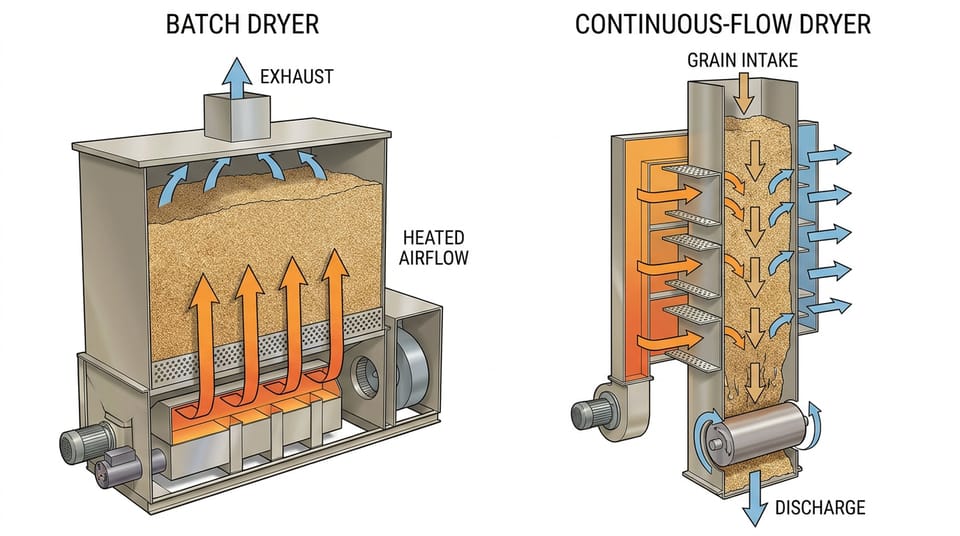
Understand the fundamental airflow and handling differences between fixed-volume batch processing and non-stop flow setu
Continuous-flow and batch grain dryers differ primarily in processing capacity, drying efficiency, labor requirements, and operating flexibility. Continuous-flow dryers are designed for uninterrupted, high-volume grain processing, while batch dryers process a fixed quantity of grain in separate drying cycles, making them suitable for smaller or more diversified farming operations.
Comparison Factor | Continuous-Flow Grain Dryer | Batch Grain Dryer |
|---|---|---|
Operating Method | Continuous grain feeding and discharge | Fixed-volume drying cycles |
Processing Capacity | Generally high, suitable for sustained grain intake | Limited by batch capacity and cycle duration |
Drying Efficiency | High throughput with reduced interruptions | Efficient for smaller or variable grain volumes |
Energy Efficiency | Can benefit from steady-state operation and heat recovery | Depends on dryer design, loading rate, and cycle management |
Labor Requirements | Lower routine labor per ton when automated | More frequent loading, unloading, and cycle management, especially for manual systems |
Initial Investment | Generally higher | Generally lower |
Operating Flexibility | Best suited to consistent, high-volume grain intake | Suitable for different crops and moisture levels |
Infrastructure Requirements | Wet grain storage, continuous feeding, and conveying systems | Relatively flexible installation and grain handling |
Suitable Farm Scale | Medium to large farms and commercial grain facilities | Small to medium farms and diversified farming operations |
Continuous-flow grain dryers generally offer higher daily processing capacity and lower labor requirements per ton when operating at or near their rated capacity. Automated feeding, moisture monitoring, and discharge control help reduce manual intervention during peak harvesting periods.
Batch grain dryers offer greater flexibility for farms handling smaller grain volumes, different crop varieties, or varying initial moisture levels. Although loading and unloading between cycles may increase labor requirements, their lower initial investment and flexible operation can make them more economical for seasonal drying needs.
The overall operating cost depends on annual grain volume, moisture removal requirements, fuel consumption, electricity prices, and the level of automation.
Examine how varying thermal patterns, air distribution methods, and kernel agitation mechanisms differentiate modern equ
Modern agricultural facilities assess drying machinery by how heat application, air routing, and kernel agitation interact across batch and continuous designs. Selecting the correct system requires evaluating your harvest scale, available energy sources, and kernel preservation goals. The following eight designs represent distinct mechanical configurations engineered to balance daily processing demands with long-term grain quality.
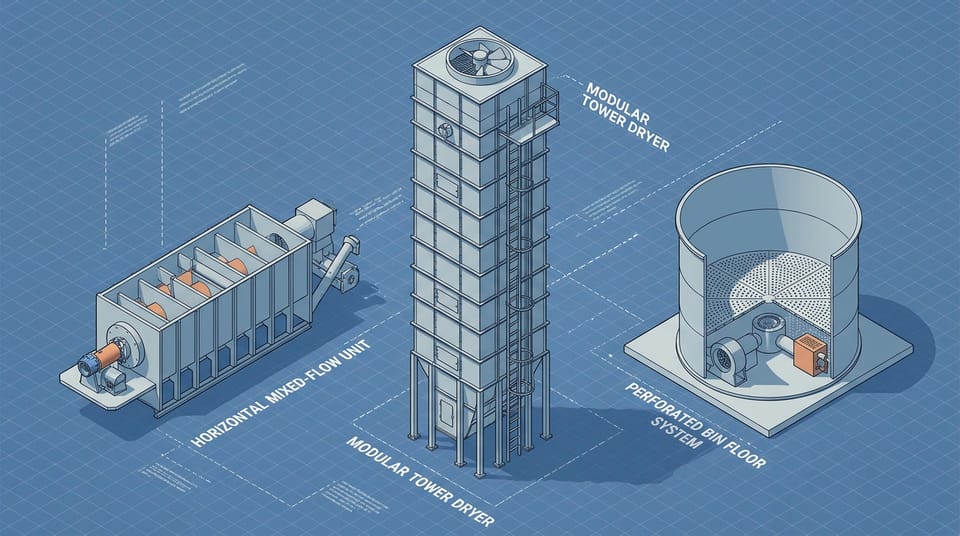
Unheated in-bin systems rely entirely on atmospheric air conditions to condition grain inside standard on-farm storage bins. You force ambient airflow upward through a full perforated floor using high-pressure axial or centrifugal fans.
Airflow Delivery: Aeration fans force ambient air through a perforated false floor, moving a drying front slowly upward through the stationary grain mass over several weeks.
Energy Profile: System operation eliminates fuel burner consumption entirely, drawing electrical power solely to operate fan motors.
This design succeeds best when incoming crop moisture remains below 18% and regional harvest weather provides consistently low relative humidity.
Low-temperature circular batch systems protect kernel integrity by recycling grain through gentle heating zones. You recirculate the grain mass vertically while applying moderately heated air across multiple passes.
Circulation Mechanism: Central vertical augers continuously lift grain from the hopper base and redistribute it across drying chambers to prevent stagnant hot spots.
Thermal Management: Modulated burner manifolds maintain plenum temperatures at modest levels, drastically reducing thermal shock and internal kernel stress cracking.
This architecture serves farm-level installations managing fragile seed grains or food-grade crops where milling quality outweighs rapid hourly throughput.
Continuous cross-flow screen column systems process high volumes by dropping grain between parallel perforated sheets. Heated air blows perpendicular to the downward grain path, creating an inherent temperature gradient across the column.
Cross-Flow Dynamics: Air travels horizontally from an internal pressurized plenum through the descending grain bed and vents through perforated outer screens.
Moisture Equalization: Mechanical grain turners invert the grain stream halfway down the column to prevent over-drying on the interior wall while leaving the exterior damp.
This design fits commercial harvests requiring high daily throughput, provided you use differential discharging rolls to balance moisture differentials.
Mixed-flow configurations eliminate exterior screens by directing air through staggered rows of triangular ducts. As grain flows downward, it cascades around alternating intake and exhaust ducts, inducing continuous tumbling.
Duct-Driven Airflow: Heated air enters open-bottom inlet ducts, passes through the tumbling grain, and exits through interspersed exhaust channels to treat every kernel uniformly.
Operational Efficiency: Mixed-flow configurations typically consume 1,600 to 2,200 BTU per pound of water removed, achieving a 15% to 25% efficiency gain over conventional screen designs.
The screenless design also reduces debris emissions and exhaust noise while processing dense grain beds without clogging.
Automated precision platforms incorporate Proportional-Integral-Derivative (PID) control loops to stabilize internal thermodynamic variables. Rather than relying on manual adjustments, the central controller calculates error values between sensor feedback and setpoints.
Algorithmic Modulation: The PID algorithm continuously adjusts burner valves and discharge metering rolls according to real-time temperature and moisture sensor inputs.
Error Suppression: Automated feedback loops maintain discharge grain temperatures within tight operational tolerances regardless of variations in incoming moisture.
Adopting automated PID control eliminates operator error, protecting your grain from excessive fuel burn and phantom shrinkage caused by over-drying.
Commercial-scale tower systems organize continuous moisture extraction inside tall vertical structures that maintain high processing volumes within a compact physical footprint. Grain descends via gravity through distinct thermodynamic stages.
Zoned Tower Architecture: Upper sections deliver high-temperature drying, intermediate zones recover warm exhaust air, and lower chambers cool grain prior to discharge.
Heat Recovery: Blowers pull ambient air through dried kernels at the base, preheating intake air while cooling grain to safe storage temperatures.
Tower units deliver uninterrupted processing capacity, making them standard installations for commercial grain elevators and large agricultural holdings.
Mobile batch units integrate complete drying assemblies onto wheeled chassis, enabling field-side relocation across multiple farm yards. They operate independently using integrated loading augers powered by tractor power take-off (PTO) shafts or electric drives.
Chassis Integration: A road-ready trailer frame carries the grain holding tank, burner, fan, and unloading auger, eliminating the expense of permanent concrete foundations.
Decentralized Logistics: The towable assembly travels between dispersed yard sites to condition distinct parcels without blending separate harvest lots.
While industrial processing operations often utilize continuous mechanical systems reviewed in research on the application of a rotary dryer for drying of agricultural products, mobile trailers serve decentralized farm yards prioritizing flexibility.
Solar-assisted drying platforms harness renewable thermal energy to preheat intake air before it reaches the grain chamber. These systems direct ambient air through solar thermal collectors to elevate air temperatures naturally.
Solar Thermal Collection: Glazed collector panels absorb diurnal solar radiation, raising intake air temperatures to lower relative humidity without burning fossil fuels.
Off-Grid Adaptability: Low-wattage blowers run on supplemental photovoltaic power, establishing self-contained conditioning capacity in remote or developing regions.
Because drying rates depend on daily solar cycles, you should reserve solar-assisted configurations for low-capacity installations or low-latitude daylight conditions.
Key Takeaways
Rely on unheated in-bin drying only when ambient harvest humidity is consistently low and incoming grain moisture is under 18%.
Adopt low-temperature recirculating batch dryers for food-grade and seed crops to minimize thermal stress cracks and protect milling quality.
The eight grain dryer designs differ not only in airflow patterns and heating methods but also in operating capacity, labor requirements, and suitability for different farm sizes. The following table compares their operating modes, processing characteristics, and typical agricultural applications.
Grain Dryer Design | Operation Type | Processing Capacity | Suitable Farm Scale | Best Applications |
|---|---|---|---|---|
Unheated Natural Air In-Bin Dryer | Stationary In-Bin / Batch | Low | Small to medium farms | Low-moisture grain and long-term storage |
Low-Temperature Circular Batch Dryer | Batch | Low to medium | Small to medium farms | Seed grain, rice, and food-grade crops |
Continuous Cross-Flow Screen Column Dryer | Continuous | Medium to high | Medium to large farms | High-volume commercial grain drying |
Mixed-Flow Grain Dryer | Primarily continuous | Medium to high | Medium to large farms | Uniform drying of corn, wheat, and other grains |
Automated PID-Controlled Precision Dryer | Batch or continuous | Model-dependent | Small to large farms | Automated moisture and temperature control |
Commercial-Scale Tower Continuous Dryer | Continuous | Very high | Large farms and commercial grain facilities | Large-volume harvesting and centralized grain processing |
Mobile Farm-Level Batch Dryer | Batch | Low to medium | Small to medium farms | Dispersed farmland and flexible drying operations |
Solar-Assisted Heated Air Dryer | Batch or continuous, depending on design | Typically low | Small farms and decentralized operations | Low-energy drying in sunny regions |
Farm size is an important consideration when determining grain drying requirements. However, planted acreage alone does not determine the required dryer capacity. Crop yield, harvesting duration, initial moisture content, and daily wet grain intake must also be considered.
Farm Size | Illustrative Planted Area | Typical Drying Requirements | Recommended Dryer Designs |
|---|---|---|---|
Small Farm | Below 50 hectares | Seasonal and small-volume drying | Natural air in-bin, mobile batch, solar-assisted dryers |
Medium-Sized Farm | 50–200 hectares | Regular grain drying during harvest | Circular batch, automated batch, mixed-flow dryers |
Large Farm | 200–1,000 hectares | High daily grain intake and extended operating hours | Continuous cross-flow, mixed-flow, automated continuous dryers |
Large Commercial Farm | Over 1,000 hectares | Sustained high-volume grain processing | Continuous tower and high-capacity mixed-flow dryers |
Commercial Grain Processing Center | Multiple farm suppliers | Centralized, large-volume grain intake | Commercial continuous tower dryers and automated drying systems |
These acreage ranges are illustrative rather than fixed equipment capacity limits. Farms should calculate their required daily drying capacity based on expected crop yield, peak harvest volume, available operating hours, and the amount of moisture that needs to be removed.
For farms with limited seasonal grain volumes, batch grain dryers can provide a practical balance between investment cost and operational flexibility. For larger agricultural operations with sustained grain intake, continuous-flow grain dryers can reduce processing bottlenecks and improve labor productivity.
Evaluate critical purchasing criteria—including capital limits, utility availability, and thermal thresholds—to accurate
Selecting the ideal conditioning system requires aligning capital constraints, thermal thresholds, and on-farm utility availability with seasonal intake goals. Unheated or low-temperature setups protect seed germination viability and minimize kernel stress cracks, whereas high-volume continuous towers prioritize throughput using aggressive plenum temperatures.
Dryer Design Category | Capital Investment Profile | Operating Temperature Range | Typical Energy Type | Practical Daily Throughput |
|---|---|---|---|---|
Low-Heat In-Bin Systems | Low upfront expenditure | Ambient to +5–10°C rise | Electricity, solar-heated grain dryer collectors | Low (seasonal conditioning) |
Portable Batch Units | Moderate expenditure | 38°C to 65°C | Liquid propane (LP), tractor PTO | Moderate (field-by-field) |
Continuous Tower Units | High expenditure | 60°C to 110°C+ | Natural gas, heavy-phase electric | High (commercial intake) |
Your choice hinges on intended market end-use and energy infrastructure. If preserving milling grade or producing certified seed, implement low-temperature batch methods to prevent stress fractures; conversely, invest in natural-gas-fired continuous platforms when high daily processing speeds outweigh marginal energy surcharges.
Key Takeaways
Prioritize low-temperature batch or in-bin designs when preserving germination viability and milling grades is critical to your market end-use.
Opt for continuous tower platforms powered by natural gas when maximizing daily commercial intake volume outweighs energy and capital expenses.
Master systematic thermal management practices to maximize moisture extraction rates while preventing internal stress cr
Balancing moisture removal speed against kernel integrity requires executing disciplined thermal management protocols across your harvest operations. Following systematic adjustments prevents internal stress fractures, test-weight degradation, and fungal spoilage in storage.
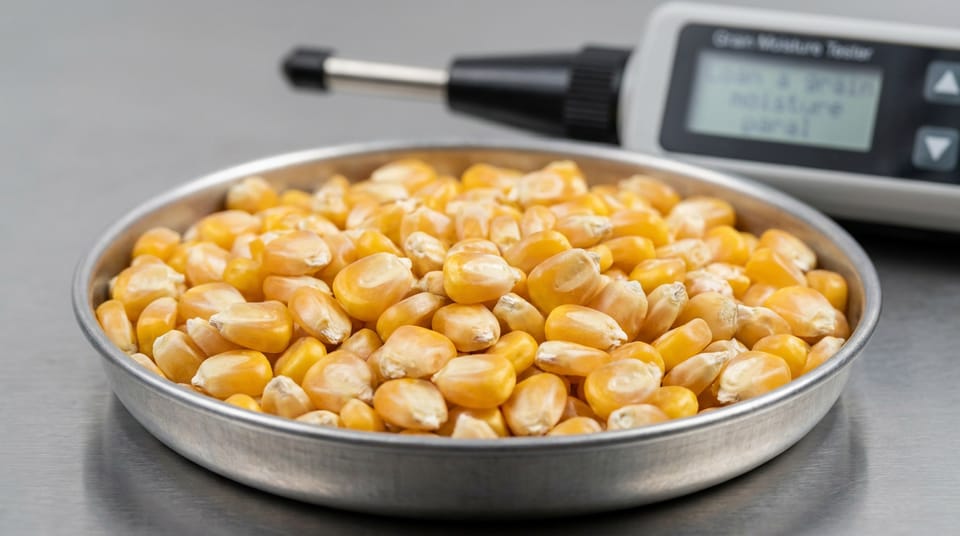
1. Calibrate sensors against ambient baselines: Cross-reference intake moisture probes with bench testers and record ambient humidity before feeding wet batches into your Grain Dryer.
2. Adjust burner setpoints to crop specifications: Restrict plenum heat to lower thermal thresholds for food-grade milling and seed crops, reserving intense heat bands strictly for feed stocks.
3. Audit discharge cooling performance: Regulate lower cooling chambers to ensure grain drops within ambient equilibrium temperatures before conveying it to final storage bins.
Bypassing the discharge cooling step transfers residual heat into cold bulk bins, creating immediate condensation along interior walls that accelerates fungal proliferation despite compliant core moisture readings.
Key Takeaways
Calibrate intake moisture sensors against bench testers and ambient baselines prior to loading wet grain batches.
Tailor burner temperatures to crop destination by restricting heat for seed and food-grade lots and reserving elevated temperatures for feed grain.
Ensure grain is thoroughly cooled to ambient equilibrium levels before binning to prevent interior condensation and fungal growth.
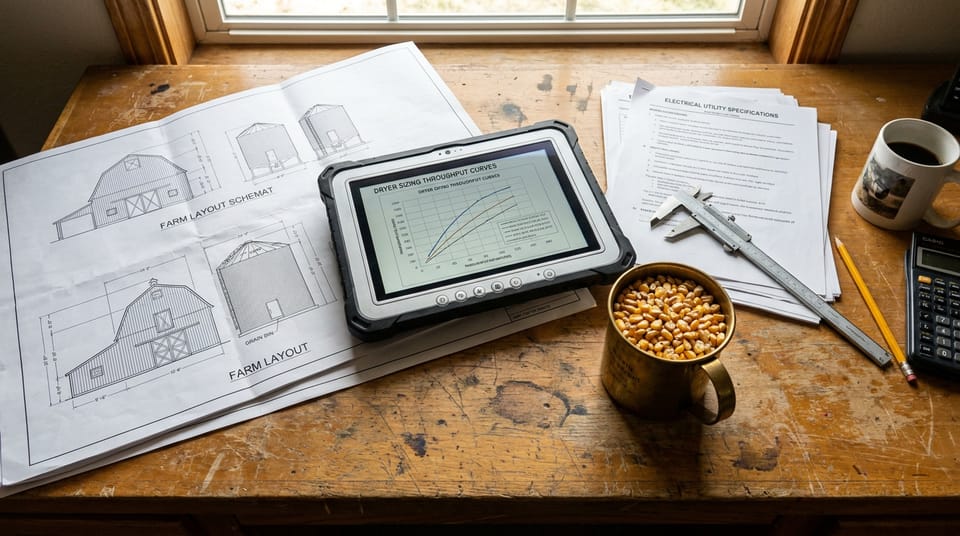
Selecting between continuous and batch dryers requires aligning your seasonal acreage and daily intake rates with available site infrastructure. Implementing modern mixed-flow or circulating low-temperature architectures paired with automated PID controls safeguards kernel structural integrity against thermal shock. Before commissioning any Grain Dryer, verify your local electrical service, burner fuel supply, and crop-specific temperature tolerances to ensure long-term conditioning efficiency.
Continuous grain dryers generally offer higher daily processing capacity and lower labor costs per ton because grain feeding, drying, and discharge can operate continuously with automated controls. They are particularly suitable for large-scale harvesting operations and commercial grain processing facilities.
Batch grain dryers process grain in separate cycles and typically require more frequent loading, unloading, and operational supervision. However, their lower initial investment and greater operating flexibility make them a cost-effective solution for small and medium-sized farms.
Energy efficiency depends on the dryer design, heat recovery system, incoming grain moisture, and actual operating capacity.
Small farms typically benefit from mobile batch dryers, low-temperature batch dryers, natural air in-bin systems, or solar-assisted dryers. Medium-sized farms may use higher-capacity batch dryers or mixed-flow grain dryers, depending on their daily harvest volume.
Large farms and commercial grain processing facilities generally benefit from continuous cross-flow, mixed-flow, and tower grain dryers because these systems support sustained high-volume processing with reduced manual handling.
Automated PID-controlled drying systems can be integrated into both batch and continuous dryers to improve moisture control and reduce routine manual adjustments.
Initial moisture levels determine how many percentage points of water the system must extract per hour, directly pacing the column dwell time. When crops arrive at elevated moisture thresholds such as 25 percent rather than 18 percent, discharge metering rolls must slow down to ensure sufficient vapor release. This mechanical deceleration reduces total metric tonnage processed per shift, requiring operators to stage wet holding buffers during heavy intake days.
Stress cracks develop when steep moisture and thermal gradients form between the kernel interior and the outer seed coat. Applying aggressive plenum heat causes outer layers to shrink rapidly around a saturated endosperm, creating structural tension that fractures the kernel during subsequent handling. Regulating burner exposure and utilizing temper periods allow internal moisture to equalize toward the surface without compromising kernel integrity.
Operations can switch between disparate crops provided the equipment allows variable heat regulation, adjustable screen perforation, and thorough internal cleanout. Oilseeds like soybeans or canola carry higher natural oil concentrations and delicate hulls, necessitating substantially lower operating temperatures than durable cereal grains to prevent scorching and fire hazards. Complete evacuation of previous crop residues from internal augers and baffles is also essential to prevent cross-contamination.
Stationary facilities operating long harvest windows benefit from three-phase electric connections due to lower maintenance demands, steady motor torque, and unattended automation capabilities. Tractor-driven power take-off options suit mobile configurations across scattered field yards where utility access is absent or cost-prohibitive. However, dedicating an active tractor to power intake and exhaust fans increases auxiliary fuel burn and diverts rolling machinery away from field operations.
Elevated outdoor relative humidity decreases the moisture-holding capacity of ambient intake air before it reaches the heating chamber. The burner must consume additional thermal energy simply to expand the air volume and lower its vapor saturation point sufficiently to absorb water from the kernel bed. Under damp harvest weather, thermal consumption per pound of extracted water rises, diminishing standard fuel economy across both continuous and mixed configurations.