T: +86-18367823571
E: lyy@xg1688.cn
E: lyy@xg1688.cn
Building 2, No. 84, Qingxi Dongfeng Road, Qingxi Town, Dongguan City, Guangdong Province, 523642, China

Views: 0 Author: Site Editor Publish Time: 2026-06-16 Origin: Site
Table of Contents
Choosing between a crawler tractor and a wheel tractor depends primarily on field conditions, required tasks and transportation needs. Crawler tractors provide a large ground-contact area, strong traction and better flotation on soft, muddy or uneven land. Wheel tractors generally offer higher travel speeds, easier road transport and simpler maintenance on firm ground.
Neither type is universally better. A crawler tractor may be the more practical option for wet paddy fields, loose soil, slopes and demanding tillage, while a wheel tractor often performs better on dry, level fields or farms with widely separated plots.
This guide compares crawler and wheel tractors in terms of traction, soil compaction, maneuverability, speed, operating cost and typical applications so that you can select the more suitable machine for your farm.
Choose a crawler tractor when your farm has soft soil, muddy fields, slopes or conditions where traction and flotation are more important than travel speed.
Choose a wheel tractor when you mainly work on firm, level ground, frequently travel between fields or need a versatile machine with simpler maintenance and lower transport costs.
For farms with both wet and dry conditions, the right choice should be based on the most demanding field condition rather than farm size alone.
Comparison factor | Crawler tractor | Wheel tractor |
|---|---|---|
Ground-contact system | Continuous rubber or steel tracks | Agricultural tires |
Best terrain | Soft, wet, muddy, loose or sloping ground | Firm, dry and relatively level ground |
Traction | Generally stronger in difficult field conditions | Efficient on firm surfaces |
Ground pressure | Usually lower because weight is spread over a larger area | Usually higher at tire contact points |
Travel speed | Generally slower | Generally faster |
Road transport | May require additional transport planning | Easier between fields and on suitable roads |
Turning behavior | Depends on steering and track design | Familiar and responsive steering |
Maintenance | Undercarriage requires regular inspection | Tire and steering maintenance is generally simpler |
Typical applications | Wet-field tillage, heavy pulling and difficult terrain | Seeding, spraying, transport and general farm work |
Main limitation | Higher undercarriage wear and slower transport | Greater risk of slipping or sinking on soft ground |
The primary difference is the system that transfers engine power to the ground. A crawler tractor moves on continuous tracks, while a wheel tractor uses pneumatic agricultural tires. This structural difference affects traction, ground pressure, speed, steering and suitability for different field conditions.
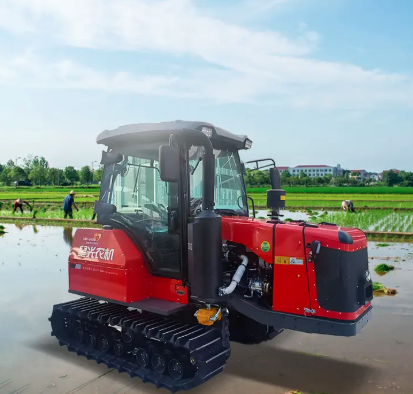
A crawler tractor uses rubber or steel tracks supported by rollers, sprockets and other undercarriage components. The tracks create a large contact area between the machine and the ground.
This design provides several advantages:
Distributes machine weight over a wider area
Improves flotation on soft or wet soil
Provides strong traction on mud, loose ground and slopes
Enhances stability during demanding field operations
However, the undercarriage requires regular inspection. Tracks, rollers, sprockets and tensioning components may experience faster wear when frequently operated on hard or abrasive surfaces.
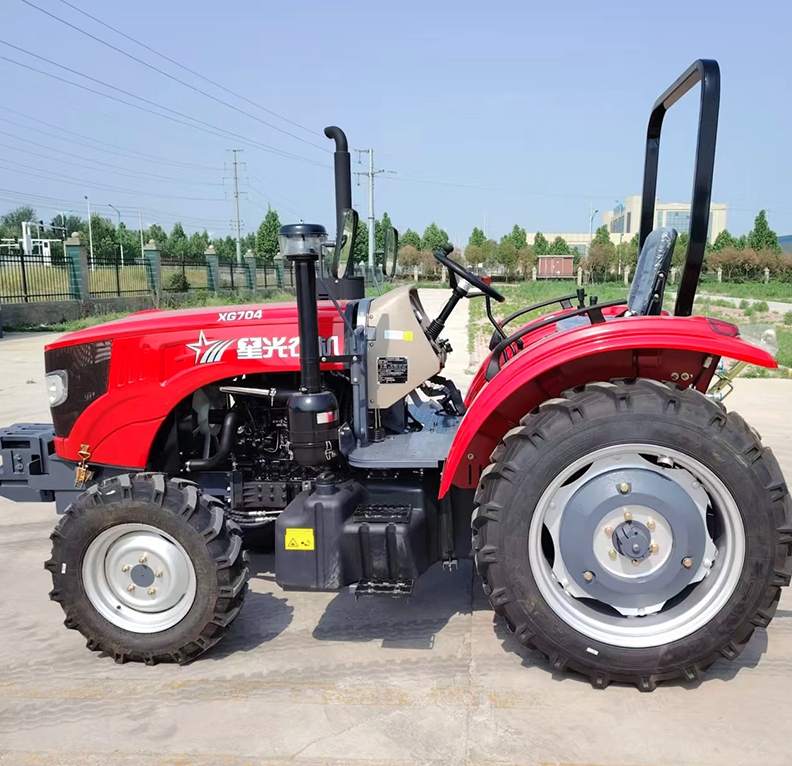
A wheel tractor transfers power through agricultural tires. Different tire sizes, tread patterns, inflation pressures and ballast configurations can be selected according to the crop, implement and field condition.
Compared with a crawler tractor, a wheel tractor generally offers:
Higher travel speed
Easier movement between fields
Simpler tire replacement and maintenance
Greater versatility for transport and general farm work
Wheel tractors perform efficiently on firm and relatively level land. However, their smaller ground-contact area may increase wheel slip or sinking when the soil becomes soft, loose or saturated.
Wheel tractors normally steer by changing the angle of the front wheels. Their familiar steering behavior makes them practical for row operations, transport and frequent maneuvering.
Crawler tractors turn by changing the speed or drive force between the left and right tracks. The actual turning performance depends on the steering system and machine design. Some models can make tight turns, although aggressive turning may disturb soft soil or damage the field surface.
In practical terms, crawler tractors prioritize traction, flotation and stability, while wheel tractors prioritize speed, mobility and versatility.
Traction determines how effectively a tractor converts engine power into usable pulling force. Soil moisture, surface strength, slope, implement load, machine weight and operator settings all influence field performance.
Crawler tractors generally provide better traction on soft, muddy or loose soil. Their continuous tracks maintain a large contact area with the ground, helping the machine move forward without concentrating its weight on a few small points.
This makes crawler tractors suitable for:
Wet paddy fields
Loose or recently tilled soil
Muddy farm roads
Sloping or uneven land
Heavy pulling operations
Wheel tractors can also work in challenging conditions when equipped with suitable tires, four-wheel drive, correct ballast and appropriate tire pressure. However, tires may still slip or sink when the soil has insufficient bearing strength.
Excessive slip wastes fuel, reduces working efficiency and may damage the soil surface. A tracked undercarriage usually maintains more consistent ground contact, which helps transfer power during demanding tillage or pulling operations.
Wheel tractors perform efficiently when the tires can grip firm soil. Tire selection, inflation pressure and ballast must be matched to the tractor and implement. Adding too much ballast increases soil pressure and fuel consumption, while insufficient ballast can increase wheel slip.
Crawler tractors are commonly selected for deep tillage, heavy harrowing, land preparation and other operations that require sustained pulling force. Their stable undercarriage can help maintain steady movement when field resistance changes.
Wheel tractors are well suited to seeding, fertilizing, spraying, mowing, hauling and general-purpose work. They can also perform heavy tillage on firm ground when properly configured with suitable horsepower, tires, ballast and implements.
The best choice therefore depends on field conditions and workload—not horsepower alone. A wheel tractor may be more efficient on firm land, while a crawler tractor may use its available power more effectively where traction is limited.
Soil compaction occurs when machinery compresses the soil and reduces pore space. Compacted soil may limit water infiltration, air movement and root development. The actual impact depends on machine weight, ground-contact area, soil moisture, travel frequency and operating method.
Crawler tractors distribute their weight across long, wide tracks. This larger contact area usually produces lower average ground pressure than tires carrying a similar load.
Lower ground pressure can help:
Limit deep ruts in soft fields
Protect prepared seedbeds
Maintain access during wet-field operations
Reduce surface disturbance when driven carefully
This advantage is particularly useful in rice paddies, wetlands and fields with low soil-bearing capacity.
However, tracks do not eliminate soil compaction. A heavy crawler tractor can still compact deeper soil layers. Sharp turns may also disturb the surface, especially when the soil is wet.
Wheel tractors concentrate their load through the tire contact areas. Soil pressure may increase when the tractor carries heavy implements, uses excessive ballast or operates with incorrect tire inflation.
Compaction risks can be reduced by:
Selecting suitable tire sizes
Setting tire pressure for field conditions
Using only the ballast required for traction
Avoiding unnecessary passes
Keeping heavy machinery off saturated soil
Following controlled traffic lanes where practical
Wide tires, dual tires and other flotation options can increase the contact area and improve wheel tractor performance on softer ground.
Crawler tractors generally provide better flotation and lower surface pressure in soft or wet conditions. Wheel tractors can protect soil effectively on firm fields when tire pressure, ballast and operating routes are properly managed.
The better choice depends on soil strength and moisture. Farmers should compare total machine weight and actual ground-contact configuration instead of assuming that every tracked machine causes less compaction than every wheeled tractor.
Terrain is often the most important factor when comparing a crawler tractor with a wheel tractor. The selected machine must maintain traction, stability and operating efficiency under the farm’s actual soil and field conditions.
A crawler tractor is generally more suitable when the ground is soft, wet, loose, uneven or sloping. Its tracks distribute weight over a larger area and provide stable contact with the surface.
Typical crawler tractor applications include:
Tillage in wet paddy fields
Land preparation on soft soil
Deep plowing and heavy harrowing
Work on loose or sandy ground
Operations on moderate slopes
Pulling heavy implements in difficult conditions
Reclamation and field-leveling work
Crawler tractors may also be useful where wheeled machines frequently lose traction or create deep ruts. Operators must still evaluate slope angle, soil strength and machine stability before working on difficult terrain.
A wheel tractor is usually the more efficient choice on firm, dry and relatively level ground. Its higher travel speed and broad implement compatibility make it suitable for general farm operations.
Typical wheel tractor applications include:
Seeding and planting
Fertilizer application
Crop spraying
Mowing and forage work
Light and medium tillage
Trailer hauling
Front-loader operations
Frequent movement between fields
Wheel tractors are particularly practical for mixed farms that require one machine to perform several tasks throughout the season.
Field condition or task | Usually more suitable | Main reason |
|---|---|---|
Wet or muddy paddy field | Crawler tractor | Better flotation and traction |
Soft or loose soil | Crawler tractor | Reduced sinking and stronger grip |
Sloping or uneven terrain | Crawler tractor | Greater contact area and stability |
Heavy pulling or deep tillage | Crawler tractor | Consistent traction under load |
Dry and firm field | Wheel tractor | Efficient movement and operation |
Seeding, spraying and fertilizing | Wheel tractor | Speed and maneuverability |
Trailer and material hauling | Wheel tractor | Better transport efficiency |
Frequent travel between fields | Wheel tractor | Faster and easier road movement |
Mixed seasonal farm work | Wheel tractor | Wider general-purpose versatility |
These recommendations are not absolute. Tractor power, machine weight, track or tire configuration, implement requirements and operator experience should also be considered before making a final decision.
Field performance is only one part of tractor selection. Turning behavior, travel speed and movement between work sites can significantly affect daily productivity.
Wheel tractors use front-wheel or articulated steering, depending on the machine design. Their predictable steering and ability to travel efficiently along headlands make them suitable for planting, spraying and other operations that require repeated turns.
Crawler tractors turn by changing the speed or drive force between the two tracks. Some models can turn within a small area, but sharp tracked turns may disturb soft soil, damage planted surfaces or increase undercarriage wear.
The practical turning space of either tractor depends on:
Tractor dimensions and steering design
Attached implement width and length
Row spacing and headland size
Soil condition
Operator technique
For small or irregular fields, buyers should compare the complete tractor-and-implement combination rather than judging maneuverability from the tractor alone.
Crawler tractors are designed primarily for traction and stability. They usually operate at lower travel speeds, especially on firm roads where tracks can experience additional heat and wear.
Wheel tractors generally travel faster in the field and between work sites. This can reduce non-working time when a farm has several separated plots or when the tractor frequently moves between fields, storage areas and service locations.
Actual speed depends on the model, transmission, load, road conditions and local operating rules.
A wheel tractor can often move directly between nearby fields where road use is permitted. This makes it practical for farms with scattered land or frequent transport work.
A crawler tractor may require a trailer for longer transfers. Transport planning should consider:
Machine width and weight
Track type
Travel distance
Trailer capacity
Loading and unloading access
Local road restrictions
For a farm concentrated around one difficult field area, crawler traction may outweigh slower travel. For widely separated fields, the mobility of a wheel tractor may provide greater overall efficiency.
The purchase price does not represent the full cost of a tractor. Buyers should also evaluate fuel use, maintenance, wear parts, transport, downtime and expected annual working hours.
Crawler tractors often have a higher purchase cost than wheel tractors with similar engine power. Their tracked undercarriage contains additional components, including tracks, rollers, idlers, sprockets and tensioning systems.
Wheel tractors are available across a wider range of sizes and configurations. They may offer a lower entry cost for farms that mainly work on firm land and do not require the traction of a crawler machine.
However, prices vary considerably by horsepower, transmission, hydraulic capacity, attachments and specification. Buyers should compare machines configured for the same workload rather than relying only on engine power.
Crawler tractor maintenance should include regular inspection of:
Track tension and alignment
Track shoes or rubber tracks
Rollers, idlers and sprockets
Undercarriage lubrication points
Mud, stones and crop residue around the tracks
Operating frequently on hard or abrasive surfaces may accelerate undercarriage wear.
Wheel tractor maintenance usually focuses on:
Tire condition and inflation pressure
Wheel alignment and fasteners
Steering and braking systems
Ballast configuration
Tire damage and tread wear
Tires are often easier to inspect and replace than a complete tracked undercarriage. Local availability of parts and trained service personnel should be considered for both tractor types.
Fuel consumption depends on engine load, traction, slip, travel speed, field resistance and implement matching. A crawler tractor may use power efficiently in difficult soil because its tracks reduce slip. On firm ground or during transport, a wheel tractor may complete the work with less travel time and lower undercarriage wear.
Fuel comparisons should therefore be based on the same task and field condition, not fuel use per hour alone. Fuel consumed per hectare or per completed operation provides a more useful measure.
Before purchasing, estimate the following costs over the intended ownership period:
Cost factor | Questions to evaluate |
|---|---|
Purchase price | What equipment and attachments are included? |
Fuel | How much fuel is required per hectare or task? |
Routine maintenance | Which filters, fluids and adjustments are required? |
Wear parts | What is the expected cost of tires or undercarriage parts? |
Transportation | Is a trailer required to move between fields? |
Downtime | Are spare parts and technical support locally available? |
Resale value | Is there demand for this tractor type in the local market? |
A crawler tractor may justify its higher ownership cost when difficult terrain would cause frequent slipping, delays or field damage with a wheel tractor. A wheel tractor may offer better value where mobility, versatility and simple maintenance are the main priorities.
The right tractor should match the farm’s most demanding conditions while remaining practical for everyday operations. Use the following factors to compare crawler and wheel tractors.
Start with the conditions that most often limit field access or productivity.
Consider:
Is the soil commonly wet, muddy or loose?
Does the tractor frequently sink or lose traction?
Are there slopes or uneven surfaces?
Is soil compaction a major concern?
Does the farm have firm access roads?
A crawler tractor is usually more suitable when soft ground, mud or slopes regularly restrict wheeled equipment. A wheel tractor is often more efficient when most work takes place on firm and level land.
List the operations the tractor will perform and rank them by importance.
A crawler tractor may be preferred for:
Heavy tillage
Deep plowing
Wet-field preparation
Land leveling
Pulling implements under difficult conditions
A wheel tractor may be preferred for:
Seeding and planting
Spraying and fertilizing
Mowing
Front-loader work
Trailer hauling
General-purpose farm operations
The tractor must also provide suitable PTO power, hydraulic capacity, linkage compatibility and operating speed for the intended implements.
Field size alone should not determine tractor type. Shape, access and distance between plots are equally important.
A wheel tractor may be more practical for scattered fields because it can travel faster between work sites. A crawler tractor may be more suitable when work is concentrated in one area with difficult ground conditions.
Also check whether the crawler tractor requires a trailer for longer transfers.
Choose a crawler tractor when traction and flotation directly affect whether the work can be completed. Choose a wheel tractor when mobility, speed and multi-purpose use provide greater operational value.
For farms with mixed conditions, consider which limitation creates the greatest cost:
Delays caused by poor traction
Time lost moving between fields
Soil damage or rutting
Transport and trailer requirements
Seasonal demand for different implements
Before buying either tractor type, confirm:
Availability of spare parts
Access to trained service personnel
Expected delivery time for wear parts
Maintenance tools and facilities
Warranty and technical support
Compatibility with locally available fluids and filters
For crawler tractors, specifically check the supply of tracks, rollers, idlers and sprockets. For wheel tractors, confirm tire sizes and replacements are readily available.
When possible, evaluate the tractor with the intended implement and in conditions similar to the actual farm.
During the test, observe:
Starting and steering response
Traction and slip
Turning space
Implement control
Operator visibility and comfort
Soil disturbance
Travel and working speed
A field test provides more useful information than comparing horsepower or purchase price alone.
Choosing a tractor based only on price or horsepower can lead to poor field performance and higher long-term costs. Avoid these common mistakes when comparing crawler and wheel tractors.
Two tractors with similar engine power may perform differently because of their weight, transmission, traction system and implement configuration.
Confirm that the tractor can provide the required:
Drawbar pull
PTO power and speed
Hydraulic flow and pressure
Three-point linkage capacity
Working speed
Implement compatibility
Power is important, but it must be usable under the farm’s actual field conditions.
A field that is firm during inspection may become soft or muddy during planting or rainy seasons. Tractor selection should reflect the most challenging conditions in which the machine must operate.
Review drainage, soil type, rainfall patterns and previous problems with sinking or wheel slip. If wet conditions regularly prevent field access, crawler traction may be more valuable than higher travel speed.
A less expensive tractor is not always the lower-cost choice. Poor traction, frequent downtime, unsuitable implements or unavailable spare parts can increase operating expenses.
Compare fuel use, maintenance, wear components, transport requirements and expected working life together with the purchase price.
Crawler tractors may need a suitable trailer for long-distance movement. Buyers should confirm transport width, machine weight, loading access and trailer capacity before purchase.
Wheel tractors are usually easier to move between fields, but buyers must still check local road requirements and ensure the machine is suitable for the planned route.
Before buying, confirm that routine service items and critical wear parts are available within an acceptable delivery time.
Crawler tractor buyers should pay particular attention to tracks, rollers, idlers and sprockets. Wheel tractor buyers should verify local availability of suitable tires and steering components.
The tractor and implement must function as one system. An unsuitable implement may overload the tractor, reduce working quality or create unsafe operating conditions.
Before selecting a tractor, confirm:
Implement dimensions and weight
Required PTO speed and power
Hydraulic connections
Hitch category
Transport position
Recommended operating speed
Specifications cannot fully show how a tractor will perform on a particular farm. Whenever possible, test the machine with the intended implement under representative soil and terrain conditions.
A field test can reveal traction limitations, excessive slip, difficult steering, poor visibility or implement compatibility problems before purchase.
Is a Crawler Tractor Better Than a Wheel Tractor?
Neither tractor is better for every farm. A crawler tractor is generally better for soft, wet, muddy or sloping terrain. A wheel tractor is usually better for firm fields, faster travel, general farm work and frequent movement between locations.
Which Tractor Is Better for Wet and Muddy Fields?
A crawler tractor is normally more suitable for wet and muddy fields. Its tracks create a larger ground-contact area, helping reduce sinking and maintain traction. Machine weight, soil depth and field drainage must still be evaluated.
Do Crawler Tractors Cause Less Soil Compaction?
Crawler tractors usually exert lower average surface pressure because their weight is distributed over a larger area. However, total machine weight, soil moisture, travel frequency and turning behavior also affect compaction. Tracks do not completely eliminate soil damage.
Can a Wheel Tractor Work in Muddy Conditions?
A wheel tractor can operate in moderately soft conditions when equipped with suitable tires, four-wheel drive, correct ballast and appropriate tire pressure. In deep mud or saturated soil, it may experience more slip or sinking than a comparable crawler tractor.
Which Tractor Is Better for Heavy Tillage?
Crawler tractors often perform well in heavy tillage because their tracks provide stable traction under load. A properly configured wheel tractor can also perform heavy tillage effectively on firm ground with suitable horsepower, tires, ballast and implements.
Which Tractor Is Easier to Maintain?
Wheel tractors generally have simpler running gear, and tires are often easier to service or replace. Crawler tractors require additional undercarriage maintenance, including inspection of tracks, rollers, idlers, sprockets and track tension.
Which Tractor Uses Less Fuel?
Fuel efficiency depends on the task and field condition. A crawler tractor may reduce energy lost through slip on difficult ground. A wheel tractor may use less time and fuel during transport or work on firm surfaces. Compare fuel consumption per hectare or completed task rather than per hour alone.
Can a Crawler Tractor Travel on Roads?
Some crawler tractors can travel short distances on suitable roads, depending on track type and local rules. However, prolonged travel on hard surfaces can increase track wear. A trailer may be required for longer transfers.
What Should I Check Before Buying a Tractor?
Check the soil and terrain, main farm tasks, required power, implement compatibility, field layout, transport distance, maintenance capacity and local parts support. Whenever possible, test the tractor with the intended implement under representative field conditions.
A crawler tractor is usually the stronger choice for wet soil, mud, loose ground, slopes and operations that demand consistent traction. A wheel tractor is generally more suitable for firm fields, faster travel, transport work and farms that need one machine for several seasonal tasks.
The final decision should be based on soil conditions, terrain, implements, transport distance, maintenance support and total ownership cost. Compare both tractor types under real operating conditions whenever possible instead of selecting by horsepower or purchase price alone.