


T: +86-18367823571
E: lyy@xg1688.cn
E: lyy@xg1688.cn
Building 2, No. 84, Qingxi Dongfeng Road, Qingxi Town, Dongguan City, Guangdong Province, 523642, China

Views: 0 Author: Site Editor Publish Time: 2026-01-09 Origin: Site
Choosing the right combine harvester requires more than comparing price and engine power. The machine must match your crop type, harvest area, available harvest window, field conditions and required processing capacity. Header compatibility, feeding capacity, grain tank size, machine dimensions, operating cost and local parts support should also be considered. This guide explains the eight key factors to evaluate so you can select a combine harvester that reduces grain loss, improves harvesting efficiency and fits your long-term operating needs.
The right combine harvester should be selected according to the crops being harvested, the total harvest area, the available harvest window and expected field conditions. Farm size alone does not determine the required machine capacity.
A farm with a short harvest window or high-yield crops may require greater feeding capacity even when its total acreage is relatively small. Conversely, a larger farm may use a medium-capacity machine if harvesting can be completed over a longer period.
Different crops place different demands on the header, threshing system, concave, cleaning system and residue-handling components.
| Crop | Important Combine Harvester Requirements |
|---|---|
| Rice | Good flotation, suitable tracks or tires, adjustable threshing settings and effective cleaning under higher-moisture conditions |
| Wheat and barley | Stable feeding, efficient threshing and accurate cleaning adjustments |
| Corn | Compatible corn header, strong crop-flow capacity and effective residue handling |
| Soybeans | Low cutting capability, flexible header control and gentle grain handling |
| Rapeseed | Suitable header configuration and careful adjustment to reduce shattering losses |
Threshing difficulty also depends on crop variety, maturity, moisture content, lodging and field conditions. Before purchasing a machine, confirm which crops and headers the combine supports and how easily its threshing and cleaning settings can be adjusted.
Instead of selecting a combine only by total farm acreage, calculate how much land must be harvested each day.
Consider the following factors:
Total harvest area
Number of available harvest days
Effective harvesting hours per day
Expected crop yield
Crop moisture and residue volume
Time required for turning, unloading and moving between fields
Possible weather interruptions
A simple starting point is:
Required daily harvesting area = Total harvest area ÷ Available harvest days
For example, if 300 hectares must be harvested within 10 suitable working days, the harvesting system needs to complete approximately 30 hectares per day. The selected combine should provide enough practical field capacity to reach this target under actual operating conditions.
Manufacturer specifications often show rated feeding capacity or theoretical output. Actual field performance may be lower because of crop density, moisture, field shape, turning time, unloading and operator experience. Therefore, selection should be based on practical output rather than the maximum published figure alone.
Field size and shape affect maneuverability, header selection and daily productivity.
| Field Condition | Selection Priority |
|---|---|
| Small or irregular fields | Compact dimensions, smaller turning radius and manageable header width |
| Large and open fields | Higher feeding capacity, wider compatible headers and efficient unloading |
| Paddy or soft fields | Tracked undercarriage or low-ground-pressure configuration |
| Sloped or uneven land | Stable chassis, reliable traction and appropriate leveling capability |
| Scattered fields | Convenient transport dimensions and easier movement between fields |
The best combine harvester is not necessarily the largest model. It is the machine that can complete the required workload within the harvest window while maintaining acceptable grain loss, fuel consumption and operating cost.
Combine harvesters can be classified by their operating structure and threshing system. These are two separate considerations: the operating structure determines how the machine is powered and moved, while the threshing system determines how grain is separated from the crop.
Understanding these differences helps buyers compare machine capacity, field adaptability, maintenance requirements and total investment.
A self-propelled combine harvester has its own engine, drive system, operator station, header, threshing components and grain-handling system. Cutting, feeding, threshing, cleaning and unloading are completed in one continuous operation.
Self-propelled models generally offer:
Higher harvesting efficiency
Better integration between harvesting components
Easier speed and header control
Multiple header and crop configuration options
Less dependence on a separate tractor
They are suitable for farms, agricultural contractors and operators that require consistent output during a limited harvest window. However, purchase cost, maintenance requirements and storage space are generally higher than for smaller tractor-powered equipment.
Tractor-mounted or trailed harvesters depend on a tractor for movement, power or both. Their simpler structure and lower initial investment can make them suitable for smaller harvesting workloads.
Before selecting this type, confirm:
Required tractor horsepower
PTO speed and connection requirements
Hydraulic compatibility
Turning and field-access space
Crop and header compatibility
Expected daily harvesting capacity
These machines may reduce the initial equipment investment when a compatible tractor is already available. However, their field capacity and operating convenience may be lower than those of a self-propelled combine.
A conventional combine usually uses a transverse threshing cylinder and concave, followed by straw walkers that separate the remaining grain from the crop residue.
This design can provide:
Clear separation between threshing and straw handling
Good straw quality where long straw needs to be retained
Straightforward inspection and adjustment
Reliable performance across common cereal crops
Performance depends on crop conditions, cylinder speed, concave clearance and straw-walker capacity.
A rotary or axial-flow combine uses a longitudinal rotor to thresh and separate crops as they move through the machine. Its longer crop-processing path can support continuous material flow and high throughput.
Rotary machines may be suitable for:
High-yield crops
Heavy crop residue
Operations requiring greater processing capacity
Multiple crops with adjustable threshing settings
Actual grain quality, loss rate and fuel consumption depend on machine settings, crop moisture, feeding consistency and field conditions. Rotary design alone does not guarantee lower grain loss.
A hybrid combine typically combines a conventional threshing cylinder with one or more rotary separation components. The cylinder performs the initial threshing, while the rotor system continues separating grain from the remaining crop material.
Hybrid systems are designed to balance:
Effective initial threshing
Greater secondary separation capacity
Adaptability to changing crop volumes
Straw and residue management requirements
Because designs vary between manufacturers, buyers should compare the actual threshing path, separation area, adjustment range and supported crops rather than relying only on the term “hybrid.”
| Requirement | Suitable Option to Consider |
|---|---|
| Integrated operation and higher daily output | Self-propelled combine |
| Lower initial investment with an existing tractor | Tractor-mounted or trailed harvester |
| Cereal harvesting with an emphasis on retaining straw quality | Conventional combine |
| High crop flow and heavy residue conditions | Rotary combine |
| Combined cylinder threshing and rotary separation | Hybrid combine |
| Paddy fields or soft ground | Tracked self-propelled combine |
| Dry, firm fields and frequent road movement | Wheeled self-propelled combine |
The final choice should be based on crop type, moisture level, residue volume, required daily capacity, field conditions and available technical support. Buyers should also review the main parts of a combine harvester and their functions before comparing different threshing and separation systems.
Engine power is important when choosing a combine harvester, but horsepower alone does not determine harvesting capacity. Actual performance depends on how well the engine, header, feeding system, threshing components, cleaning area, grain tank and unloading system work together.
A suitable machine should maintain stable crop flow under expected field conditions without frequent clogging, excessive grain loss or unnecessary fuel consumption.
The engine supplies power for machine movement, cutting, feeding, threshing, separation, cleaning and unloading. Additional power may be required when harvesting:
High-yield crops
Wet or dense crop material
Heavy straw and residue
Sloped or soft fields
Crops requiring wider headers
Fields where unloading takes place while harvesting
A higher engine rating can support demanding workloads, but an oversized engine does not automatically improve field productivity. Power should match the machine’s feeding capacity, header configuration and operating conditions.
Rated feeding capacity indicates how much crop material the combine can process within a given time, commonly expressed in kilograms per second. It is often a more useful comparison point than engine power alone.
However, feeding capacity is affected by:
Crop type and yield
Grain and straw moisture
Crop density and lodging
Cutting height
Ground speed
Header performance
Threshing and cleaning settings
A rated capacity should therefore be treated as a reference value rather than a guaranteed field output. Ask the manufacturer under which crop and test conditions the stated capacity was measured.
Grain tank capacity affects how frequently the combine must stop or slow down for unloading. A larger tank may support longer harvesting intervals, but it also increases machine weight when full.
When comparing grain-handling systems, consider:
Grain tank volume
Unloading auger position and reach
Unloading rate
Compatibility with trailers or transport vehicles
Whether unloading can occur while harvesting
Field access for grain transport equipment
The right grain tank is not necessarily the largest one. It should match field length, crop yield and the availability of transport vehicles.
Theoretical capacity and actual field capacity are not the same. Turning, unloading, crop blockage, machine adjustment, field shape and operator experience all affect daily output.
| Specification | What It Helps You Evaluate |
|---|---|
| Engine power | Ability to support harvesting systems under load |
| Rated feeding capacity | Volume of crop material the machine can process |
| Cutting width | Potential field coverage per pass |
| Grain tank capacity | Frequency of unloading |
| Unloading rate | Time required to transfer harvested grain |
| Fuel consumption | Expected operating cost |
| Grain loss rate | Harvesting and adjustment performance |
| Working speed | Potential productivity under suitable conditions |
When comparing combine harvesters, request test data for crops and field conditions similar to your own. A balanced machine with stable crop flow and suitable capacity is generally more valuable than a model selected only for maximum horsepower.
The header is the first part of the combine harvester to contact the crop. Its design and cutting width affect crop intake, grain loss, field coverage and overall harvesting efficiency.
Choose the header type before comparing cutting widths. A wide header designed for the wrong crop will not provide efficient harvesting.
Different crops require different cutting and feeding methods.
| Crop or Field Condition | Header Option to Consider | Main Selection Requirement |
|---|---|---|
| Wheat and barley | Grain platform or draper header | Smooth cutting and consistent crop feeding |
| Rice | Grain header designed for paddy harvesting | Effective pickup of standing or lodged crops |
| Soybeans | Flexible or low-cut header | Low cutting height and reduced pod loss |
| Corn | Row-crop corn header | Row spacing compatibility and effective ear collection |
| Rapeseed | Grain header with suitable attachments | Reduced shattering and seed loss |
| Windrowed crops | Pickup header | Clean pickup and even feeding |
Header availability varies by combine model. Confirm the supported crops, attachment interface and adjustment range before purchasing the machine.
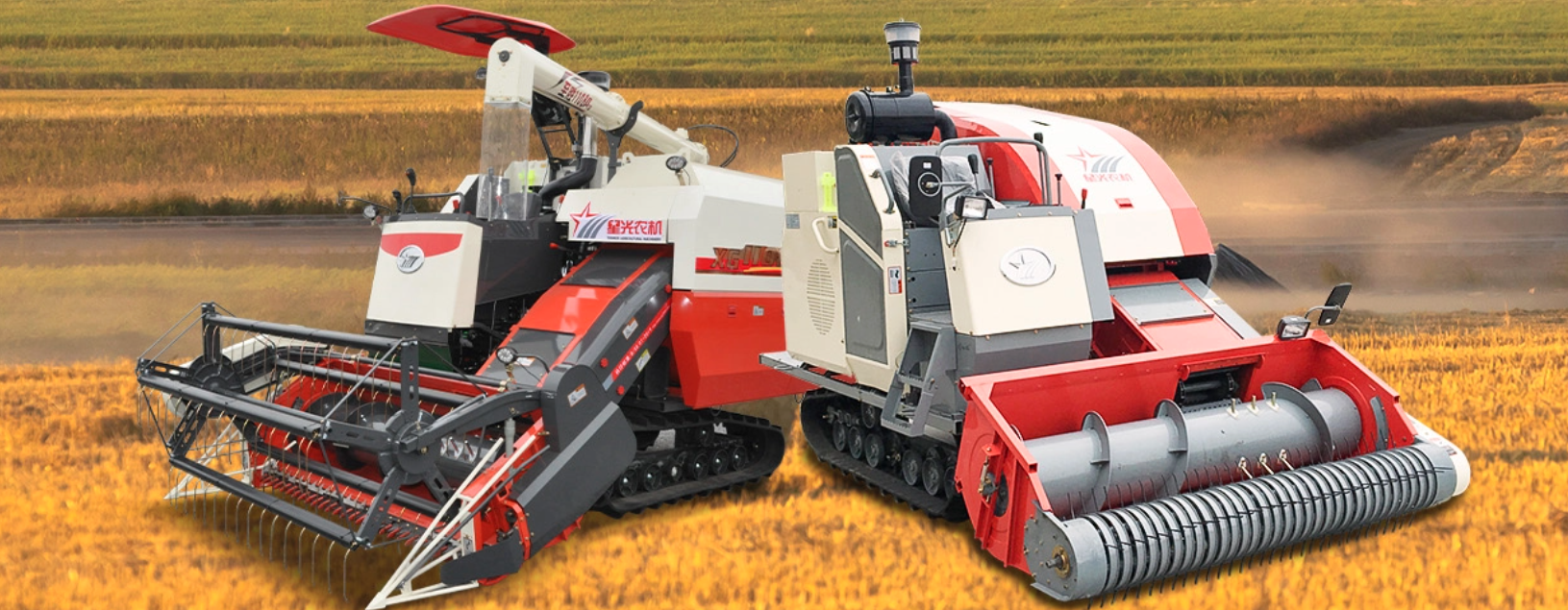
A wider header covers more ground in each pass and may increase daily output in large, open fields. However, it also requires sufficient engine power, feeding capacity and operator control.
A narrower header may be more suitable for:
Small or irregular fields
Narrow field entrances
Terraced or fragmented farmland
Frequent turning
Lower-capacity combines
Roads with transport-width restrictions
A wider header may be more suitable for:
Large and open fields
Short harvesting windows
Higher-capacity combines
Straight and longer field runs
Operations requiring greater daily coverage
The cutting width should match the combine’s rated feeding capacity. If the header supplies crop material faster than the threshing and cleaning systems can process it, blockage, uneven separation and grain loss may increase.
Crop condition is just as important as nominal cutting width. Lodged, tangled or uneven crops require accurate header-height control and stable feeding.
Useful header features may include:
Adjustable reel position and speed
Automatic header-height control
Flexible cutter-bar movement
Crop dividers
Pickup fingers
Adjustable feeding-auger clearance
These features can help maintain consistent crop intake, particularly when crop height and field surface vary.
The working width of the header may be greater than the transport width of the combine. Before selecting a wide header, check:
Field entrance and gate width
Local road-width restrictions
Bridge and roadside clearances
Header removal requirements
Availability of a header trailer
Storage-building dimensions
Time required to move between fields
A wide header may improve output in the field but create delays when fields are widely separated or access roads are narrow.
A wider header can reduce the number of passes required to harvest a field. However, this does not automatically mean lower soil compaction.
Compaction risk depends mainly on:
Total machine weight
Grain tank load
Tire or track configuration
Ground-contact area
Tire pressure
Soil moisture
Number of field passes
Header width should therefore be selected for crop intake and field efficiency, while tracks, tires and machine weight should be evaluated separately for soil protection.
The header must deliver a steady and manageable crop flow into the feeder house. Learn more about this process in our guide to how a combine harvester works.
Field conditions affect traction, maneuverability, ground pressure and harvesting stability. When choosing a combine harvester, buyers should consider whether a wheeled or tracked undercarriage is better suited to their farmland.
Neither system is suitable for every situation. The right choice depends on soil moisture, field firmness, slope, road travel, machine weight and operating cost.
Wheeled combines are commonly used on dry, firm and relatively level fields. They generally provide faster road travel and simpler movement between widely separated fields.
Potential advantages include:
Faster transport between fields
Easier road operation
Lower undercarriage maintenance requirements
Good maneuverability on firm ground
Multiple tire-size and flotation-tire options
However, narrow tires or high tire pressure may increase rutting and soil compaction, especially when the grain tank is full or the soil is wet.
Tracked combines distribute machine weight across a larger ground-contact area. A properly configured track system can improve flotation and traction in soft, muddy or wet fields.
They are often considered for:
Rice paddies
Soft or waterlogged soil
Fields with limited load-bearing capacity
Conditions where wheeled machines may sink or slip
Operations requiring stable low-speed traction
Track width, contact length, machine weight and grain load all affect ground pressure. A tracked machine should not automatically be assumed to cause less soil compaction under every condition.
| Selection Factor | Wheeled Combine | Tracked Combine |
|---|---|---|
| Dry, firm fields | Generally suitable | Suitable but may not be necessary |
| Wet or soft fields | May require flotation tires | Often provides better flotation |
| Road travel | Usually faster and more convenient | Generally slower |
| Turning resistance | Usually lower | Often higher |
| Undercarriage maintenance | Generally simpler | Requires inspection of tracks, rollers and tension |
| Initial cost | Often lower | Often higher |
| Ground pressure | Depends on tire size, pressure and load | Depends on track area, design and load |
| Paddy-field operation | May have limited traction | Commonly preferred |
Slope performance should not be judged only by whether the machine uses tires or tracks. Important factors include:
Machine center of gravity
Overall width
Weight distribution
Tire or track grip
Braking system
Grain tank load
Header control
Manufacturer-rated slope limits
Harvesting on slopes can affect machine stability, crop flow and cleaning performance. Operators should always follow the manufacturer’s operating limits and avoid working on terrain that exceeds the machine’s rated capability.
Wet soil may increase the risk of sinking, rutting and wheel slip. Before selecting a combine, evaluate:
Typical soil moisture during harvest
Frequency of muddy conditions
Soil type and bearing strength
Drainage conditions
Fully loaded machine weight
Available recovery equipment
Field-entry and turning conditions
For wet or soft fields, a tracked combine or correctly sized flotation tires may improve mobility. For firm fields with frequent road transfers, a wheeled machine may provide greater transport efficiency.
The undercarriage should be selected according to the most difficult conditions the machine is likely to encounter—not only the conditions present during a dry demonstration.
Combine harvester size and weight affect field access, soil pressure, road movement, storage and transport arrangements. These specifications should be checked before purchasing a machine, especially when fields are connected by narrow roads or have limited entrance space.
There is no single standard weight for a combine harvester. Machine weight varies according to the harvester type, engine, header, threshing system, undercarriage and grain tank capacity.
When comparing specifications, distinguish between:
Complete machine weight: The stated weight of the machine in its specified configuration
Header weight: May be included or listed separately depending on the manufacturer
Operating weight: May include fuel, fluids, operator and installed attachments
Loaded field weight: Increases when the grain tank contains harvested grain
For reference, Thinker tracked combine harvesters include the following specifications:
| Model | Complete Machine Weight | Overall Dimensions (L × W × H) |
|---|---|---|
| 4LL-2.0D Double Drum Combine Harvester | 2,765 kg | 4,680 × 2,685 × 2,605 mm |
| 4LZ-6.0Z Full-Feed Combine Harvester | 3,650 kg | 5,200 × 2,800 × 2,960 mm |
| 4LZ-7.0Z Full-Feed Combine Harvester | 3,950 kg | 5,200 × 2,800 × 2,960 mm |
These figures are model-specific and should not be treated as universal weight ranges for all combine harvesters.
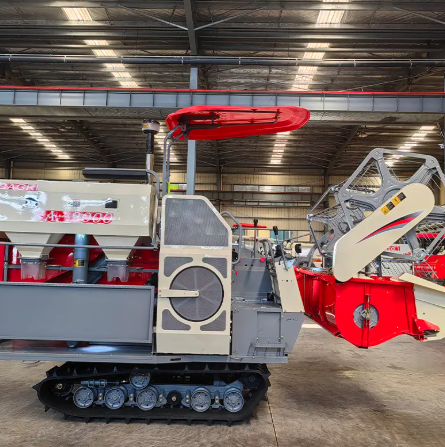
Overall dimensions determine whether the machine can enter fields, pass along local roads and fit inside storage buildings.
Measure and compare:
Overall machine length
Overall machine width
Overall machine height
Header working width
Transport width with the header attached or removed
Minimum ground clearance
Turning space
Storage entrance dimensions
Harvester height is particularly important when the machine must pass beneath doors, power lines, trees, bridges or other overhead structures. Allow additional safety clearance rather than relying on an exact fit.
Before choosing a combine harvester, inspect the complete route between storage areas and fields.
Check for:
Narrow roads and field entrances
Weight-limited bridges
Sharp turns and roadside obstacles
Soft road shoulders
Low overhead clearances
Local width and height restrictions
Requirements for warning signs or escort vehicles
A high-capacity combine may perform efficiently inside the field but still cause delays if it cannot move easily between harvesting locations.
Some combine harvesters can travel between nearby fields under their own power. Longer-distance movement may require suitable transport equipment.
Ask the manufacturer or supplier to confirm:
Transport dimensions
Machine and header weights
Whether the header must be removed
Suitable trailer or low-loader capacity
Loading-ramp requirements
Recommended lifting and securing points
Applicable local road requirements
Do not select transport equipment using complete machine weight alone. Account for the installed configuration, attachments, fluids and any other loads present during movement.
Machine weight affects flotation, rutting and soil compaction, but total weight is only one factor. Ground pressure also depends on tire or track dimensions, contact area, inflation pressure, grain load and soil moisture.
Buyers operating in rice paddies or soft fields should compare the fully loaded condition, track or tire specifications and minimum ground clearance—not only the unloaded machine weight.
Confirm all dimensions and weights on the final technical specification sheet because configurations may vary by model and market.
The purchase price is only one part of the cost of owning a combine harvester. Fuel, maintenance, replacement parts, labor, downtime and resale value can have a greater long-term impact on operating expenses.
A lower-priced machine may cost more over time if it consumes more fuel, requires frequent repairs or has limited spare-parts availability.
A new combine typically provides current specifications, manufacturer support and a known service history. A used machine may reduce the initial investment but requires a more detailed inspection.
| Factor | New Combine Harvester | Used Combine Harvester |
|---|---|---|
| Initial price | Generally higher | Generally lower |
| Service history | No previous use | Must be verified |
| Repair risk | Usually lower during early operation | Depends on age, hours and condition |
| Technology | Current features and controls | May use older systems |
| Parts availability | Confirm with manufacturer or dealer | May be limited for discontinued models |
| Warranty | May include manufacturer coverage | May be limited or unavailable |
| Depreciation | Higher during early ownership | Often slower after the initial period |
When evaluating a used combine, inspect the engine hours, threshing components, concave, sieves, bearings, belts, chains, augers, tracks or tires, hydraulic system and maintenance records.
Calculate the expected expenses over the planned ownership period.
| Cost Item | What to Include |
|---|---|
| Purchase cost | Machine, header and required attachments |
| Fuel | Consumption per hour or per hectare |
| Routine maintenance | Oils, filters, lubrication and scheduled servicing |
| Wear parts | Belts, chains, blades, concaves, sieves and bearings |
| Repairs | Labor, components and service travel |
| Labor | Operator and maintenance personnel |
| Downtime | Delayed harvesting and possible crop-quality loss |
| Storage | Suitable covered space and seasonal preparation |
| Resale value | Expected value at the end of ownership |
Request model-specific maintenance intervals and parts prices whenever possible. General estimates may not reflect the actual machine configuration or local service conditions.
Purchase price alone does not show whether a combine is economical. Comparing cost per hectare provides a more practical view of long-term value.
A simplified calculation is:
Estimated cost per hectare = Total ownership and operating costs ÷ Total harvested area during the ownership period
The calculation should include expected annual use, fuel, maintenance, repairs and resale value. A machine used across more hectares may have a lower ownership cost per hectare, provided its capacity is suitable and utilization remains consistent.
A breakdown during a short harvest window may cause more financial loss than the repair itself. Delayed harvesting can affect grain moisture, quality, field loss and the ability to complete work before adverse weather.
Before purchasing, check:
Availability of common spare parts
Typical delivery time for replacement components
Access to trained service technicians
Diagnostic support
Warranty response procedures
Recommended seasonal spare-parts inventory
An oversized combine may increase purchase, fuel and maintenance costs without delivering enough additional value. An undersized machine may extend the harvest period and increase the risk of crop loss.
The most economical option is usually the machine that completes the required workload within the available harvest window while maintaining manageable operating and maintenance costs.
A combine harvester operates during a limited and weather-sensitive harvest window. Reliable maintenance support and spare-parts availability can therefore be as important as engine power, header width and feeding capacity.
Before purchasing a machine, confirm who will provide technical assistance and how quickly common replacement parts can be obtained.
Compare the maintenance schedule of each model and check which tasks must be completed daily, seasonally or according to operating hours.
Important maintenance items include:
Engine oil and filters
Fuel and air filters
Belts and drive chains
Bearings and lubrication points
Cutter-bar sections and guards
Threshing drum or rotor components
Concave and sieve condition
Augers and grain elevators
Hydraulic fluid and hoses
Track tension or tire condition
Machines with accessible service points, clear maintenance instructions and commonly available consumables may reduce servicing time during harvest.
Ask the supplier which parts are considered normal wear items and which components should be kept in stock before the harvest season.
| Parts Category | Examples |
|---|---|
| Cutting parts | Knife sections, guards and drive components |
| Power transmission | Belts, chains, sprockets and bearings |
| Threshing and cleaning | Concaves, rasp bars, sieve components and fan parts |
| Grain handling | Auger components, elevators and paddles |
| Undercarriage | Tracks, rollers, tires and related components |
| Filters and seals | Oil filters, fuel filters, air filters and hydraulic seals |
Also confirm part numbers, prices, expected service life and delivery times. A machine with lower purchase cost may become expensive to operate if essential parts are difficult to obtain.
Operator setup has a direct effect on grain loss, grain damage, cleanliness and fuel consumption. Buyers should confirm whether the supplier provides:
Operating manuals
Maintenance schedules
Initial machine setup guidance
Operator training
Crop-specific adjustment instructions
Remote technical support
Fault diagnosis assistance
Service and repair procedures
Training should cover header adjustment, ground speed, threshing settings, concave clearance, fan speed and sieve opening.
Warranty terms vary by manufacturer, model and market. Before ordering, request written confirmation of:
Warranty period
Covered parts
Excluded wear components
Labor and service responsibilities
Claim procedures
Required maintenance records
Response process for technical problems
Avoid relying only on general statements such as “full warranty” or “complete support.” The quotation or purchase agreement should clearly define the actual coverage.
Before harvesting begins, complete a full inspection and prepare frequently used wear parts. Confirm that the operator understands routine adjustments and that supplier contact information is readily available.
When comparing Thinker combine harvesters, buyers can contact the company to confirm model-specific maintenance intervals, compatible spare parts, technical documentation and available after-sales support before placing an order.
Before requesting a quotation or choosing a model, use the following checklist to compare combine harvesters under the same operating requirements.
| Selection Factor | Information to Confirm |
|---|---|
| Crops | Rice, wheat, corn, soybeans, rapeseed or other crops |
| Harvest area | Total area and required daily harvesting workload |
| Harvest window | Number of suitable working days and hours per day |
| Feeding capacity | Rated capacity and the conditions under which it was measured |
| Engine | Rated power and suitability for the expected crop load |
| Header | Supported type, cutting width and crop compatibility |
| Threshing system | Conventional, rotary, double-drum or hybrid structure |
| Grain handling | Grain tank volume, unloading type and unloading rate |
| Field conditions | Dry, wet, muddy, soft, sloped or uneven ground |
| Undercarriage | Tires, flotation tires or tracks |
| Dimensions | Overall length, width, height and ground clearance |
| Weight | Complete machine weight and expected loaded operating weight |
| Field access | Gate width, road conditions, turning space and overhead clearance |
| Operating cost | Fuel, labor, routine maintenance, wear parts and expected repairs |
| Spare parts | Availability, price and expected delivery time |
| After-sales support | Operator training, technical guidance, diagnostic support, manuals and service availability |
Compare each machine using the same checklist rather than focusing on a single specification or purchase price. The right combine harvester should match the crops, complete the required workload within the available harvest window and remain practical to operate and maintain over its expected service Retirement.
Consider the crops, total harvest area, available harvest window, field conditions and required daily output. Then compare feeding capacity, engine power, header compatibility, grain tank capacity, machine dimensions, operating costs and spare-parts support.
Choose a machine that can complete the required harvesting area within the available number of working days. Also check whether its width, height, turning radius and header size are suitable for field entrances, roads and storage buildings.
A multi-crop combine with adjustable threshing, concave and cleaning settings can be used for rice and wheat. For wet or soft paddy fields, a tracked undercarriage may provide better flotation. Confirm crop compatibility with the manufacturer before purchasing.
Combine harvester weight varies by machine type, engine, header, threshing system and undercarriage. Thinker’s current tracked models weigh approximately 2,765–3,950 kg, depending on the model. Always confirm whether the published figure includes the header and other attachments.
Tracked combines are often suitable for rice paddies and soft or muddy fields because of their larger ground-contact area. Wheeled combines generally provide faster road travel and may be more convenient on dry, firm fields. The right choice depends on soil, transport and operating conditions.
Match the header to the crop, feeding capacity, engine power and field layout. Wider headers suit large, open fields, while narrower headers may be easier to operate in small, irregular or restricted fields.
Estimate how much land must be harvested each day, then compare the combine’s rated feeding capacity under similar crop conditions. Crop yield, moisture, straw volume, ground speed and unloading time all affect actual performance.
Inspect operating hours, maintenance records, engine condition, belts, chains, bearings, cutter-bar components, threshing parts, concaves, sieves, augers, hydraulics and the tire or track system. Also confirm spare-parts availability and service support.
The price depends on machine type, capacity, engine power, header configuration, threshing system and optional equipment. Compare total ownership cost—including fuel, maintenance, repairs, wear parts and resale value—rather than purchase price alone.
Choosing the right combine harvester requires balancing crop type, harvest area, available working time, feeding capacity, engine power, header compatibility, field conditions, machine dimensions and long-term operating costs.
The largest or most powerful machine is not always the best choice. A suitable combine should complete the required workload within the available harvest window while maintaining manageable grain loss, fuel consumption, maintenance requirements and operating costs.
Before making a final decision:
Confirm which crops and headers the machine supports
Compare rated feeding capacity under similar crop conditions
Check whether tires or tracks suit the fields
Verify machine weight, dimensions and access requirements
Review fuel use, maintenance intervals and wear parts
Confirm spare-parts availability and after-sales support
Request a complete, model-specific technical specification sheet
For a better understanding of the machine before comparing models, read our guides to how a combine harvester works and the main parts of a combine harvester and their functions. Thinker Agricultural Machinery provides combine harvesters for rice, wheat and other grain crops. Buyers can explore the available combine harvesters or contact our team to discuss crop type, field conditions and required harvesting capacity.
Need Help Choosing a Combine Harvester?Tell us your crop type, harvest area, field conditions and required daily capacity. The Thinker Agricultural Machinery team can help you compare suitable combine harvester configurations. View Combine Harvesters Contact Our Team |


