English ![]()

T: +86-18367823571
E: lyy@xg1688.cn
E: lyy@xg1688.cn
Building 2, No. 84, Qingxi Dongfeng Road, Qingxi Town, Dongguan City, Guangdong Province, 523642, China

Views: 0 Author: Site Editor Publish Time: 2026-10-15 Origin: Site
Table of Contents
Choosing between a walking and riding rice transplanter depends on your field size, terrain, planting capacity, and budget. Both machines automate rice seedling transplanting, but they differ in operating methods, working width, maneuverability, and operator comfort.
A walk-behind rice transplanter is generally better for smaller, irregular, or narrow paddy fields where maneuverability and lower initial investment matter most. A ride-on rice transplanter is usually more suitable for larger, well-prepared fields that require higher planting capacity and reduced operator fatigue.
In this guide, we compare their planting efficiency, field suitability, operating requirements, and long-term costs to help you choose the right machine for your farming operation.
Both walk-behind and ride-on rice transplanters use mechanical planting systems to transfer seedlings into prepared paddy soil. However, their operating characteristics make them suitable for different farming conditions.
Comparison Factor | Walking Rice Transplanter | Riding Rice Transplanter |
|---|---|---|
Operator Position | Walks behind the machine | Sits on the machine |
Typical Planting Rows | Commonly 4 or 6 | Commonly 6 or 8 |
Suitable Farm Size | Small to medium fields | Medium to large fields |
Field Maneuverability | Better suited to narrow and irregular plots | Better suited to larger, regular fields |
Planting Capacity | Generally lower | Generally higher |
Operator Fatigue | Requires more walking and physical effort | Reduces physical walking during operation |
Initial Investment | Generally lower | Generally higher |
Maintenance | Often simpler, depending on model | May involve more complex mechanical systems |
Best Application | Small paddies, segmented fields, and restricted access | Large paddies and commercial transplanting operations |
Quick recommendation: Choose a walk-behind model when maneuverability and initial cost are your main concerns. Choose a ride-on model when planting capacity, operating efficiency, and operator comfort are higher priorities.
Walking and riding rice transplanters are both designed to transfer nursery-grown rice seedlings into prepared paddy fields. Their main differences lie in operator position, machine configuration, planting coverage, and maneuverability.
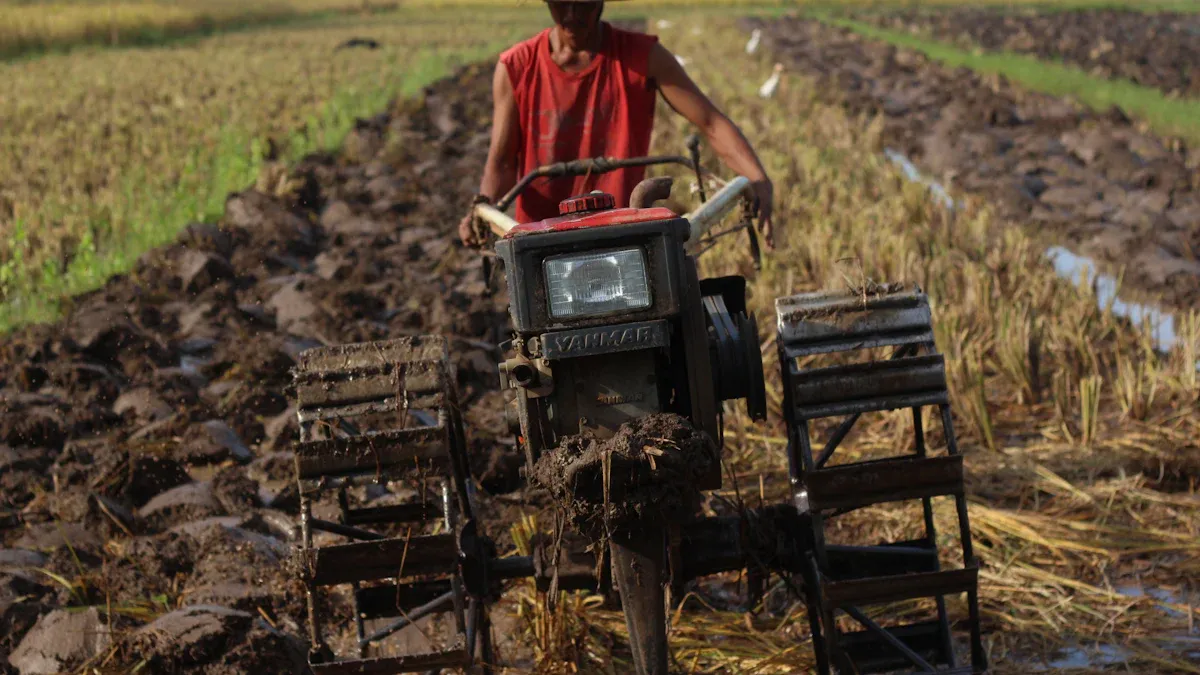
A walking rice transplanter, also known as a walk-behind rice transplanter, is a powered planting machine operated by a person walking behind it.
The operator guides the machine using handles and controls, while the seedling feeding and planting mechanisms automatically place rice seedlings into the prepared soil.
Walk-behind models generally have compact dimensions and fewer planting rows, making them suitable for smaller paddies, narrow access paths, and irregularly shaped fields.
Thinker Agri's Hand Rice Transplanter is an example of this configuration, offering a compact solution for farms where larger equipment may be difficult to maneuver.
A riding rice transplanter, also called a ride-on rice transplanter, is a self-propelled machine with a seated operator position.
The operator controls movement, steering, and planting settings while the machine's planting mechanism transfers seedlings into the paddy soil.
Ride-on models commonly use wider planting configurations, allowing them to cover more rows during each field pass.
Thinker Agri offers six-row and eight-row high-speed rice transplanter configurations designed for agricultural operations requiring greater planting coverage.
The most important distinction is how the operator controls the machine and how the equipment is configured for fieldwork.
Walk-behind transplanters prioritize compact size and maneuverability, while ride-on transplanters generally emphasize planting coverage and operator comfort.
Both types require suitable paddy preparation, compatible seedling mats, and correct planting settings to achieve consistent transplanting performance.
Planting capacity is one of the main differences between walking and riding rice transplanters. It depends on planting width, operating speed, field layout, turning time, and seedling replenishment.
Walk-behind rice transplanters typically have fewer planting rows and a narrower working width, making them easier to operate in confined fields.
Ride-on rice transplanters often feature six or eight planting rows. Their wider planting coverage can reduce the number of passes required across larger paddy fields.
However, more planting rows do not automatically guarantee higher field efficiency. Short fields, frequent turns, uneven surfaces, and seedling loading interruptions can reduce actual productivity.
When comparing two rice transplanters, evaluate their effective field capacity rather than relying only on maximum operating speed.
Actual field performance depends on:
Planting width and row configuration
Recommended transplanting speed
Field size and shape
Turning and repositioning time
Seedling tray replenishment
Soil and water conditions
For a fair comparison, request the rated working capacity of each machine under comparable operating conditions.
Practical consideration: A larger ride-on model may provide greater daily output in open fields, while a compact walk-behind model may operate more efficiently in narrow or fragmented paddies.
Field layout and soil conditions play an important role in choosing between a walk-behind and a ride-on rice transplanter. Even a machine with high planting capacity may perform inefficiently if the field is too narrow, irregular, or difficult to access.
Walk-behind rice transplanters are generally better suited to small, fragmented, or irregularly shaped paddies.
Their compact dimensions make it easier to navigate narrow access paths, turn at field boundaries, and reposition between smaller planting areas.
Ride-on models typically require more turning space, which can reduce their operating efficiency in short or irregular fields.
Ride-on rice transplanters are better suited to larger, regularly shaped fields with sufficient room for turning.
Their wider planting coverage allows operators to complete longer, uninterrupted passes, helping reduce repositioning time.
For commercial rice farms with consolidated planting areas, ride-on machines can offer higher overall field productivity.
Both types of rice transplanters are designed for prepared paddy conditions, but their performance depends on soil bearing capacity, mud depth, water level, and machine configuration.
Compact walk-behind models may offer better access to narrow terraces or segmented paddies. However, lighter weight alone does not guarantee better traction or prevent sinking in deep mud.
Ride-on models may also operate effectively in wet fields when the machine and soil conditions are suitable.
For terraced or difficult-to-access fields, evaluate the machine's dimensions, ground clearance, traction, and turning requirements before purchasing.
Field Condition | Walk-Behind Transplanter | Ride-On Transplanter |
|---|---|---|
Small, fragmented paddies | Generally more suitable | May be less efficient |
Large, regular fields | Suitable but lower potential coverage | Generally more suitable |
Narrow access paths | Better maneuverability | Requires sufficient access width |
Terraced paddies | Often easier to maneuver | Depends on terrace dimensions and access |
Deep, soft mud | Depends on traction and ground pressure | Depends on traction and ground pressure |
Limited turning space | Generally easier to reposition | May require larger turning areas |
Selection Tip: Before choosing a rice transplanter, assess field dimensions, access routes, soil conditions, and turning space rather than relying on planting capacity alone.
Labor availability and operator comfort are important considerations when comparing walk-behind and ride-on rice transplanters. Although both machines reduce the need for manual transplanting, they differ in physical effort, working conditions, and operator training requirements.
Both walk-behind and ride-on rice transplanters can typically be operated by one trained person. However, additional workers may be needed to prepare, transport, or replenish seedling mats, depending on field size and daily planting requirements.
Walk-behind models require operators to follow and guide the machine through the paddy. They are generally practical for smaller fields and shorter operating periods.
Ride-on models allow operators to control the machine from a seated position. Combined with their potentially higher planting capacity, they can help reduce total operator hours across larger planting areas.
The main difference in operator comfort is the amount of physical walking required.
Walk-Behind Rice Transplanters:
Operators walk behind the machine while steering and monitoring planting performance. This requires continuous movement and can become physically demanding during long shifts, especially in muddy conditions.
Ride-On Rice Transplanters:
Operators sit on the machine and control steering, travel speed, and planting functions from the operator's position. This reduces the physical effort associated with walking through the field.
However, actual comfort also depends on machine ergonomics, field roughness, vibration, and operating duration.
Both types of transplanters require basic operational training before fieldwork.
For walk-behind models, operators should understand machine steering, turning, planting depth adjustments, and safe movement in wet field conditions.
Ride-on models may require additional familiarization with seated controls, machine stability, turning space, and higher-capacity planting systems.
Before operation, operators should review the manufacturer's instructions, check safety controls, and practice machine handling in a suitable test area.
Practical Recommendation: For farms with limited labor availability or long daily planting schedules, ride-on transplanters may offer advantages in operator comfort and potential working capacity. For smaller or fragmented fields, walk-behind models remain a practical option when maneuverability is the higher priority.
When comparing walk-behind and ride-on rice transplanters, purchase price is only one part of the investment. Fuel consumption, maintenance, spare parts, labor requirements, and annual planting capacity also affect long-term operating costs.
Walk-behind rice transplanters generally require a lower initial investment because of their compact design and simpler operating systems. They can be a practical choice for smaller farms with limited equipment budgets.
Ride-on rice transplanters typically cost more due to their larger planting configurations, engines, and operator control systems. However, their higher potential planting capacity may help reduce operating time across larger fields.
The actual purchase price depends on the model, number of planting rows, engine specifications, optional equipment, and supplier quotation.
Both machine types require regular inspection and maintenance to maintain reliable planting performance.
Walk-Behind Transplanters:
Often feature more compact mechanical systems.
May offer easier access to certain maintenance components.
Require routine inspection of planting claws, transmission parts, and feeding mechanisms.
Ride-On Transplanters:
May include larger engines and more complex drive or control systems.
Require maintenance according to the manufacturer's service schedule.
Can involve higher repair expenses depending on component complexity and spare parts availability.
For either type, buyers should confirm the availability of replacement planting fingers, transmission components, filters, and other model-specific parts before purchasing.
A fair cost comparison should consider the total expense of operating a rice transplanter over several planting seasons.
Cost Factor | Walk-Behind Transplanter | Ride-On Transplanter |
|---|---|---|
Initial Investment | Generally lower | Generally higher |
Fuel Consumption | Often lower per operating hour | May be higher per operating hour |
Labor Requirements | More physical walking required | Reduced operator walking |
Maintenance Complexity | Often simpler | May involve more complex systems |
Field Capacity | Generally lower | Generally higher |
Cost per Hectare | Depends on annual usage and field conditions | Depends on annual usage and field conditions |
Spare Parts | Model-specific availability | Model-specific availability |
When comparing operating costs, calculate the estimated cost per hectare rather than relying only on hourly fuel consumption or purchase price.
A machine with a higher purchase price may offer better long-term value if it operates frequently and provides sufficient additional planting capacity.
For farms with smaller annual planting areas, a compact walk-behind transplanter may be more economical because of its lower initial investment.
Buying Tip: Before purchasing, request a detailed quotation, technical specifications, recommended maintenance schedule, and spare parts information. These details will help you compare the actual ownership costs of different rice transplanter models.
The best rice transplanter depends on your field size, planting conditions, required working capacity, and available budget. Rather than choosing a machine based only on planting speed or row count, consider how efficiently it can operate across your actual paddy fields.
A walk-behind rice transplanter is generally a practical choice for smaller farms and fields where maneuverability is more important than maximum planting capacity.
Consider a walk-behind model if:
Your paddies are small, narrow, or divided into separate plots.
Field access and turning space are limited.
Your initial equipment budget is relatively low.
You need a compact machine that is easier to maneuver between planting areas.
Your daily planting requirements can be met by a smaller machine.
Walk-behind transplanters are particularly useful for farms where larger ride-on equipment cannot operate efficiently. However, operators should still evaluate soil conditions, traction, and machine accessibility before making a selection.
A ride-on rice transplanter is generally more suitable for larger farms that prioritize planting capacity and operator comfort.
Consider a ride-on model if:
You manage medium or large paddy fields with regular layouts.
Your planting schedule requires higher daily field coverage.
You want to reduce the physical effort associated with walking behind a machine.
Your fields provide sufficient access and turning space.
Higher equipment utilization can help justify the initial investment.
Ride-on transplanters with six or eight planting rows can provide wider working coverage, making them suitable for larger and more continuous planting operations.
Before choosing a rice transplanter, compare the actual machine specifications with your field requirements.
Pay particular attention to planting rows, working width, operating capacity, turning space, field conditions, maintenance requirements, and spare parts availability.
A suitable machine should provide reliable planting performance without unnecessary operating complexity or equipment investment.
For model-specific recommendations, explore Thinker Agri's Rice Transplanter range or contact our team with your field size and planting requirements.
After deciding between a walk-behind and a ride-on rice transplanter, the next step is to compare specific machine configurations. Buyers should evaluate technical specifications, field compatibility, operating requirements, and after-sales support before placing an order.
Buying Factor | What to Check | Why It Matters |
|---|---|---|
Planting Rows | Number of rows and row spacing | Determines planting width and field compatibility |
Working Capacity | Rated field capacity under specified conditions | Helps estimate planting time |
Planting Depth | Available adjustment range | Supports suitable seedling placement |
Hill Spacing | Available spacing settings | Helps achieve the required planting density |
Engine and Drive System | Engine power, transmission, and fuel type | Affects operation and maintenance |
Machine Dimensions | Overall width, length, and turning requirements | Determines access to narrow fields |
Field Adaptability | Recommended soil and paddy conditions | Helps avoid traction and planting problems |
Spare Parts | Availability of planting claws and other wear parts | Reduces potential maintenance delays |
Before purchasing, confirm the following details with your equipment supplier:
What is the machine's rated working capacity, and under what conditions was it measured?
What planting depth and spacing adjustments are available?
What seedling mat dimensions are compatible with the feeding system?
Can the machine operate under my field's soil and water conditions?
Which spare parts should be prepared for routine maintenance?
What warranty terms, technical documentation, and after-sales services are included?
What are the packaging, delivery, and shipping arrangements?
Provide your supplier with your field size, average plot dimensions, soil conditions, planting requirements, and expected seasonal workload.
These details can help determine whether a walk-behind or ride-on configuration is more appropriate and which model specifications should be prioritized.
Explore Thinker Agri's Rice Transplanter product range to review available configurations and request more detailed technical information.
Thinker Agri offers rice transplanters with different operating configurations to support various field sizes and planting requirements.
Model | Configuration | Suitable Application |
|---|---|---|
Hand Rice Transplanter | Walk-behind, with row options depending on model | Small and irregular paddy fields |
2ZGQ(C)-6 High-Speed Rice Transplanter | 6-row ride-on | Medium-sized fields requiring a balance of coverage and maneuverability |
2ZGQ(C)-8 High-Speed Rice Transplanter | 8-row ride-on | Larger fields requiring wider planting coverage |
When comparing these models, consider their working width, planting capacity, field compatibility, operating requirements, and maintenance needs.
Explore the Rice Transplanter product category to review available configurations and request detailed technical specifications.
A walk-behind rice transplanter is generally better suited to smaller or fragmented paddies because of its compact design and maneuverability. However, field access, planting requirements, and equipment budget should also be considered.
Ride-on rice transplanters generally provide higher planting capacity because they often feature more planting rows and wider working widths. Actual productivity depends on machine specifications, soil conditions, field layout, and operating efficiency.
Yes. Walk-behind rice transplanters are designed for prepared paddy conditions, but their performance depends on soil bearing capacity, water depth, traction, and machine configuration. Extremely soft or uneven ground may affect planting accuracy.
Ride-on models may involve higher maintenance costs because of larger engines and more complex drive or control systems. However, actual expenses depend on machine design, operating hours, spare parts availability, and maintenance requirements.
Compare your field size, daily planting capacity requirements, row spacing, turning space, and operating budget. Four-row configurations are often suited to smaller fields, while six-row and eight-row models can provide greater planting coverage for larger agricultural operations.
Walking and riding rice transplanters serve different farming needs. Walk-behind models generally provide better maneuverability and lower initial investment for smaller or irregular fields, while ride-on models offer greater planting coverage and reduced physical effort for operators working across larger paddies.
The right choice depends on field conditions, planting capacity, and long-term operating requirements. Explore Thinker Agri's Rice Transplanter range to compare available models, or contact our team to discuss suitable configurations for your agricultural operation.